
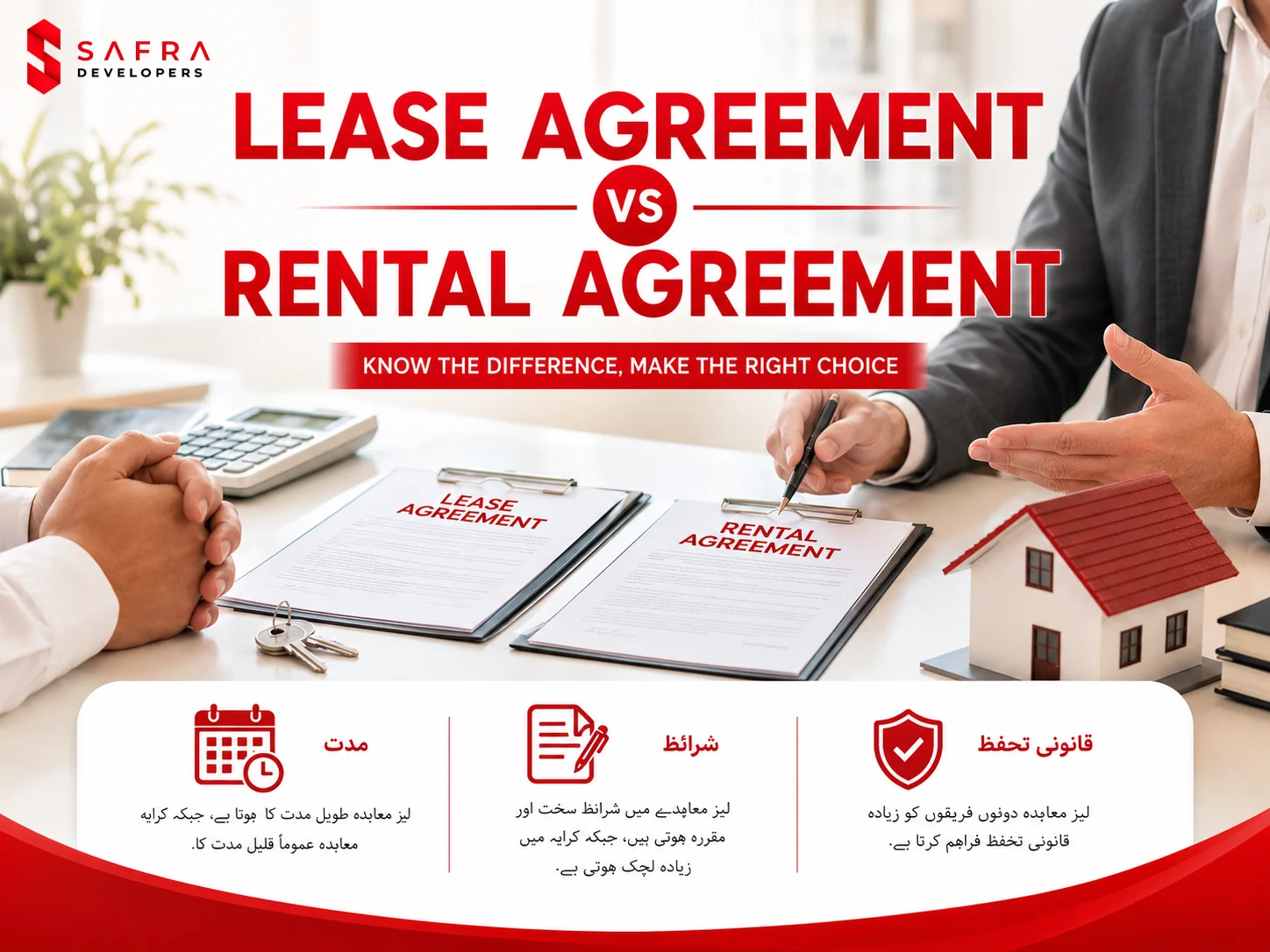
In real estate, renting properties has been a major income source and has great investment potential. When renting property, an agreement is made to legalize the process. However, whether the property should be rented or leased to utilize this potential for ones’ maximum ability can be confusing. Each type of agreement has its own terms and conditions governing its benefit for the use intended.
This blog explores both rental and lease agreements, their properties and differences.
Lease Agreement
A lease agreement is a legal contract made between a lessee and a tenant after which the tenant can use the property for a period of time. This is a fixed time period which can last from 1 year to a certain year. The contract contains all the specifications on the property use, durations, lease amount and obligations of parties involved. A lease contract is to be written on a stamp paper and registered with the land authorities after which it becomes legally binding on all parties and no changes can be done until the contract duration completes.
Lease Agreement Uses: Lease agreements are often made for renting of commercial properties or high-value residential properties. Specifically its uses include:
I. Renting Commercial buildings and Properties
II. Renting agricultural properties
III. Renting residential properties for long durations
Pros and Cons of Lease Agreement
Every contract has its own strengths and weaknesses. Cost-benefit ratio of lease agreement depending on the intended purpose of the party governs the use of lease agreements in property renting. Some pros and cons are mentioned below:
Pros
➢ A lease agreement ensures income consistency for the lessee.
➢ It also ensures to the tenant that rent will not be raised during the lease period.
➢ Lease agreements reduce tenant turnover due to long-term contracts.
➢ The contract cannot be changed once finalized saving tenants from any future uncertainty.
Cons
➢ Lessee cannot change tenants after the agreement even if the tenants are not friendly.
➢ In case of market fluctuations, the rent amount cannot be changed and so can result in losses.
➢ Tenants are bound for a long-duration and are not able to move or change locations in case of better opportunities or less money availability.
➢ Termination of lease contracts can result in legal cases and penalties.
Rental Agreement
Rental Agreement is a type of contract made between a renter and tenant which allows the tenant to use the property for a certain period of type, where the time period is usually a short duration. This contract can be changed after agreement or within contract term as well making it flexible to the needs of both the parties. Contracts of less than 1 year need not to be registered in most cases.
Rental Agreement Uses: Rental agreements are often made for residential houses, apartments, commercial shops and apartments for a short time period.
Pros and Cons of Rental Agreement
Like lease agreements, rental agreements also have certain pros and cons which are mentioned below:
Pros
➢ Rental agreements allow greater flexibility to both parties as the terms and conditions of the contract can be changed.
➢ Renter can easily increase the rent in response to market scenarios.
➢ Renter can easily change tenants if they are unfriendly
➢ The tenants can move-out in case of any better opportunity.
Cons
➢ Since the contract is short-term it can easily be terminated without legal consequences.
➢ Can create losses for renters due to high tenant turn-over.
➢ The rent amount can be increased at any time putting the tenant at a disadvantage.
Similarities in Lease & Rental Agreement
The common similarities between both agreements are:
- Both are legally binding contracts resulting in legal actions if violated.
- Both include a renter and tenant which decide the terms and conditions in writing on a contract.
- The renter receives while the tenant pays the rent.
- In both agreements a deposit amount is to be submitted as a security.
- The usage conditions and maintenance responsibilities are clearly explained in contract.
- How any violations or disputes will be dealt are stated in the agreement.
Differences Between Rental And Lease Agreements
| Sr. No. | Rental Agreement | Lease Agreement |
|---|---|---|
| 1. | It is a short-term agreement with max. 11 month duration | It is a long-term agreement with min. 1 year duration |
| 2. | Can be ended with a notice | Until the lease duration finishes, it cannot be ended. |
| 3. | Involves lower security deposits | Involve higher security deposits |
| 4. | Contract conditions such as maintenance responsibilities, rent amount etc. can be changed during contract period | Contract conditions can be changed during contract period |
| 5. | Since it can be terminated any time it results in higher tenant turnover rates. | Has lower tenant turnover rates due to longer lease durations which cannot be altered until lease period ends. |
| 6. | Does not require very formal documentation and also no need for registration for agreements less than 11 months | Involves an extensive legally binding documentation which needs to be registered. |
| 7. | The rental contract is renewed itself with next month's payment. | Lease contracts need to be renewed through the defined process every time the contract ends. |
| 8. | Used for normal residential properties | Used mostly for long term residential property as well as commercial properties. |
Which Contract is Suitable: Rental or Lease?
The suitability of any agreement totally depends on the needs of the tenant or renter. If a renter is looking forward to continuous and uniform income and a long-term investment opting for a lease agreement is better. However if the renter prioritizes his control on the property use, access, tenants and options to benefit from market fluctuations, a rental agreement will be best for him.
For a tenant, if they are more interested in long-term stay with stable use conditions that are legally backed as well, common in cases of businesses, lease agreements are suitable. While if a tenant wants freedom to move out of contract due to any situation or a better opportunity, rental agreements can be opted for.
Both rental and lease agreements have their own distinct properties governing their use in property rentings. Lease agreement which provides stability and legality is often less flexible to accommodate any changes for needs of the parties. Rental agreement where it is flexible and convenient does not guarantee continuous income flow and evacuation-proof security for tenants with less legal constraints. The cost benefit trade offs for each contract determines its use and benefit to each involved party.