
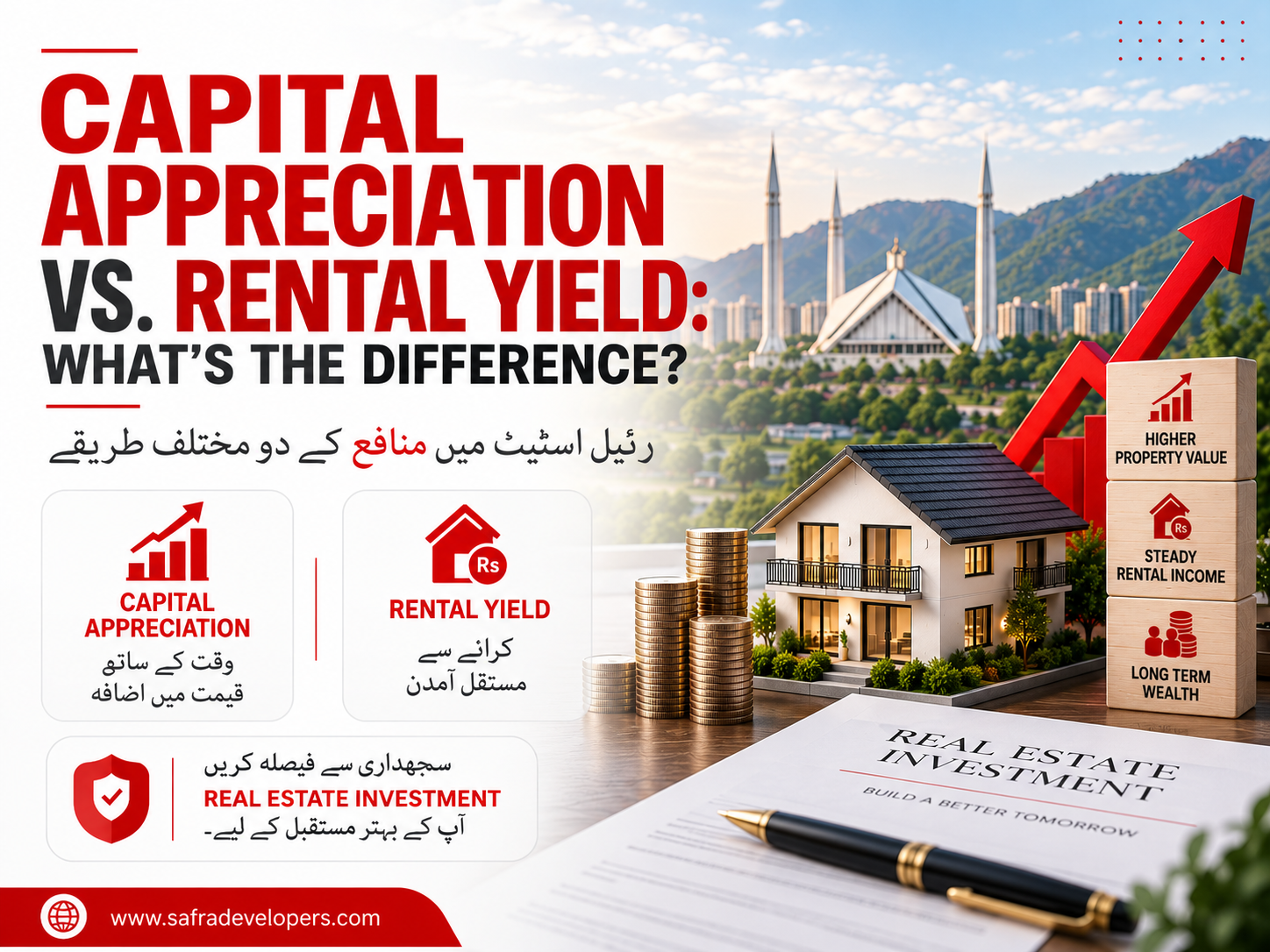
Real estate is often considered a beneficial investment option since it provides a good return on investment (ROI) over time. However, the form in which the ROI is generated can be different. When considering profits from real estate investments, two common terms emerge: capital appreciation and rental yield. Though both terms are often used interchangeably due to the perception that they are the same, each of the two has its own meaning and value. This article will explain capital appreciation and rental yield and differentiate them from one another.
What is Capital Appreciation?
The increase in the market value of a property over a period of time is referred to as capital appreciation. For example, you purchase a property of PKR 2 lac, and over a period of 10 years the value (resale value) of the property increases to 5 lac. The increase of 3 lac in the property value is the capital appreciation of the property over 10 years.
Features of Capital Appreciation
Capital appreciation of any property mostly has the following characteristics:
- It is a one-off gain realized only when the property is sold.
- Much depends on the location, the extent of infrastructure built, and overall market demand.
- It rewards patience, because most of the appreciation is gradual over years.
- This is the main one for investors who buy a property, hold it long term, and hope the area develops and prices rise.
Importance of Capital Appreciation
The capital appreciation is the profit you will eventually make on property resale. This is especially critical for investors who are building long-term wealth, as a prime piece of real estate in a developing area can multiply in value over a period of years. That makes it more relevant for buyers who don’t need immediate income and are prepared for a long-term property hold.
What is Rental Yield?
Rental yield is the rate of return a property generates in rental income. For example, a property with a value of PKR10 lac producing PKR 85,000 in terms of annual rental income will have a rental yield of 8.5%.
Features of Rental Yield
Rental yield of any property mostly has the following characteristics:
- You get a steady income, paid monthly or at intervals by the tenants.
- It is contingent upon the property location and type, and tenant demand.
- It rewards investors looking for a steady cash flow, not a one-time, lump-sum gain.
- This is the key to investors who purchase property specifically to rent it out.
Importance of Rental Yield
Rental yield is a fantastic way to get a regular income along with a gradual increase in property value over time, instead of having your money tied up with no return in the interim. This is important for investors who require regular cash flow for monthly expenses. A property with a high rental yield can also protect an investment from turbulent market dynamics. more resilient in times when the broader market is not appreciating quickly, as it still generates income even if resale value is flat for a while.
Differences Between Capital Appreciation And Rental Yield
| Factor | Capital Appreciation | Rental Yield |
| Type of Gain | One-time gain realized at the time of sale | Ongoing, recurring rental income |
| Timeframe | Realized over several years | Realized monthly or periodically |
| Best Suited For | Long-term investors and patient property holders | Investors seeking regular cash flow |
| Main Driver | Market conditions and location growth | Tenant demand and prevailing rental rates |
| How It Is Measured | Difference between purchase price and sale price | Annual rental income as a percentage of property value |
| When You Access the Gain | Only after selling the property | While continuing to own the property |
Similarities Between Capital Appreciation And Rental Yield
| Aspect | How It Applies to Both |
| Goal | Both aim to increase an investor's overall return from owning property |
| Influenced by Location | A well-located property can support both stronger capital appreciation and higher rental demand |
| Requires Ongoing Costs | Both are affected by expenses such as property taxes, maintenance, and society dues, which can reduce net returns |
| Market-Dependent | Both can increase or decrease depending on real estate demand, economic conditions, and market trends |
| Part of Total Return | Together, capital appreciation and rental yield contribute to a property's overall return on investment rather than functioning as completely separate strategies |
Both capital appreciation and rental yield represent the profit coming from a real estate investment, with the difference that capital appreciation is the increase in value of property with time, while rental yield is the income coming from renting out a property. Each has its own benefits and importance, given the preferences of the investor.