
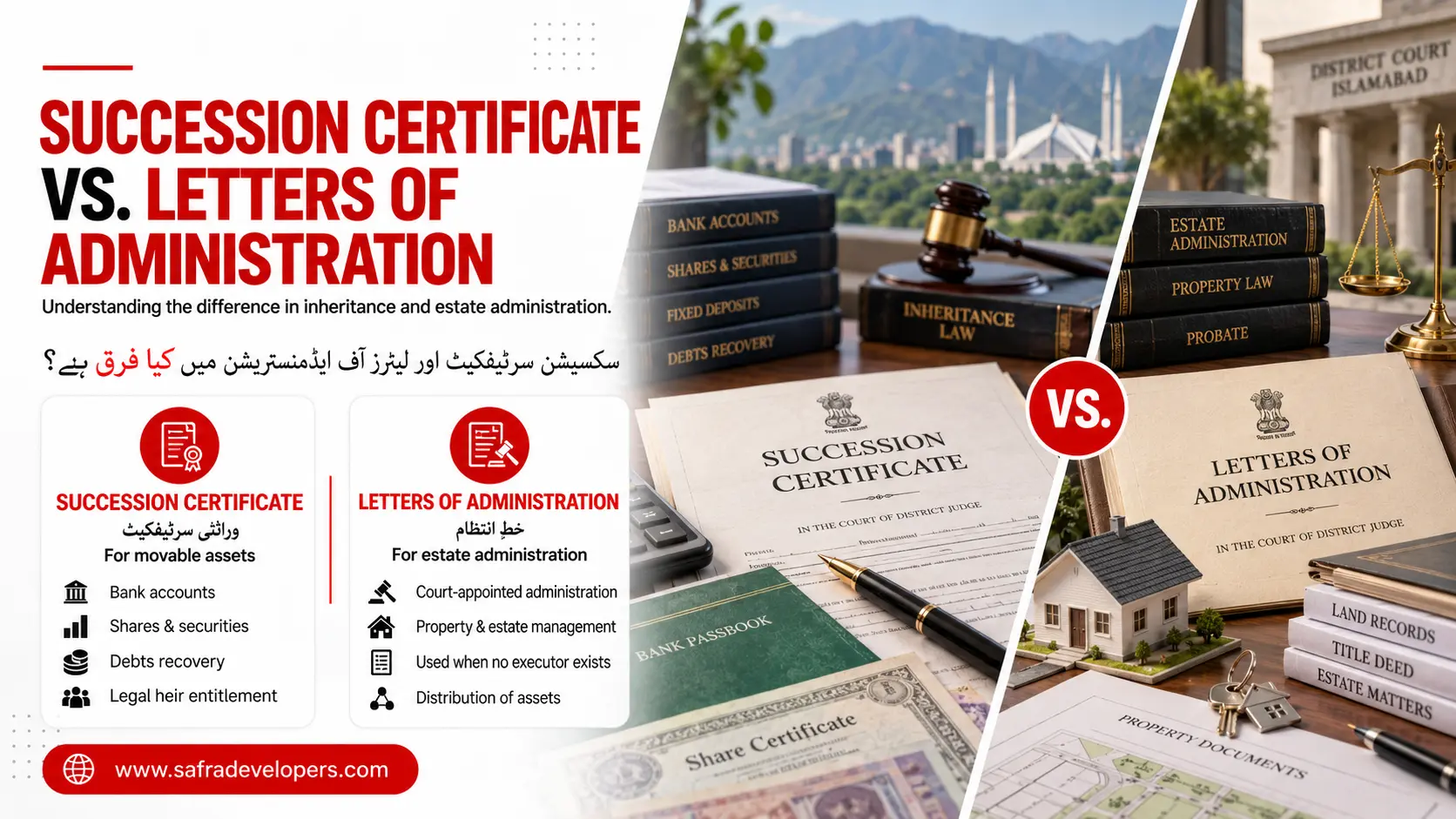
When discussing property-related matters, inheritance is an important topic. To receive any sort of property of the deceased, the successors have to show proof that they are the rightful heirs. This is mostly done through a Succession Certificate or Letters of Administration. Both of these documents are for the same purpose, but their functions are different. In this article, the succession certificate and the letter of administration will be discussed so that their difference can be easily understood.
What Is a Succession Certificate?
In simple terms, a Succession Certificate can be referred to as a legal document provided to the heirs by a court of law that authorizes a person to receive the debts and securities of a deceased person. It is like the authority to deal with the movable assets of the deceased.
How Does a Succession Certificate Work?
It is often used for things like bank accounts, provident funds, shares, and other financial assets. The Succession Act, 1925 governs its issuance. It is not valid for immovable property such as land or houses. Usually, the applicant should be a legal heir. The court process involves publication of a public notice before the certificate is issued so that any objections can be made.
What Are Letters of Administration?
A court grants Letters of Administration to appoint a person to be the legal administrator of the whole estate of a deceased person who died without a valid will (died "intestate").
How Do Letters of Administration Work?
It applies to the whole estate, both movable and immovable. It empowers the administrator to control, transfer, and conclude the business of the deceased as a whole. It is also provided under the Succession Act, 1925. Usually necessary for more complicated types of estates, involving more than one type of asset, including property.
The Need For Succession Certificate And Letters of Administration
When someone dies, his property does not automatically go to his heirs, someone needs legal authority from a court to access, manage or distribute what is left behind. Banks, share registrars and land authorities won’t simply hand over assets to a family on their say-so, or even a death certificate alone; they require formal proof that the person requesting access has the legal right to do so. This is where a Succession Certificate and Letters of Administration come into the picture. They provide the legal authority to the heirs to actually claim and manage the assets of a deceased person be it a bank account, shares, property or the estate in general.
Succession Certificate vs. Letters of Administration: How Are Both Different?
Both Succession Certificate and Letters of Administration have the following contrasting differences:
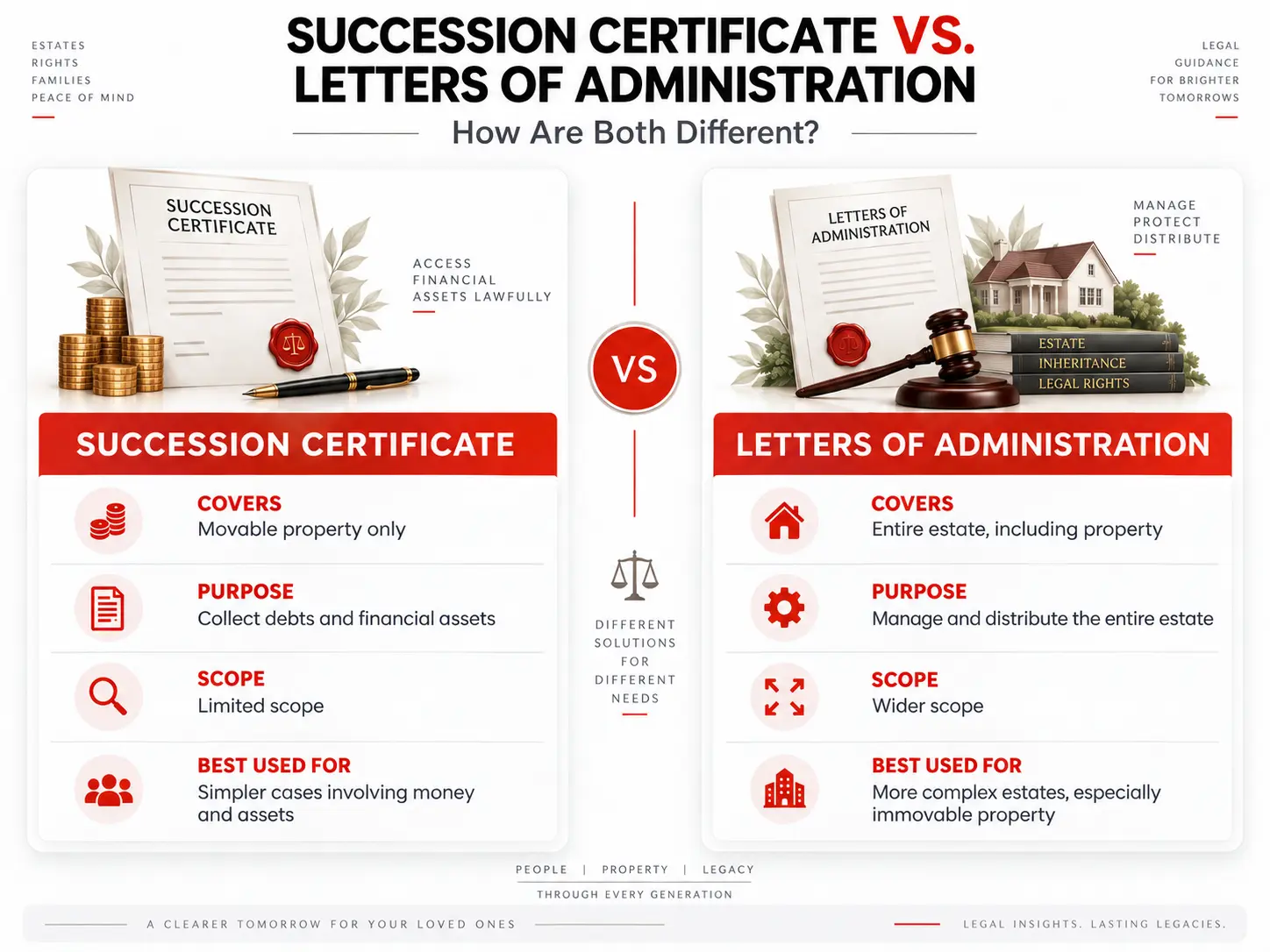
- Covers: Succession Certificate applies only to movable property, while Letters of Administration also cover the entire estate (including property).
- Purpose: A Succession Certificate is mostly used to collect debts and financial assets. Letters of Administration are used to manage and distribute the entire estate.
- Scope: The scope of a Succession Certificate is limited, while the scope of Letters of Administration is wider.
- To be used: The Succession Certificate is used for easier cases mainly involving money and assets, while Letters of Administration are used for more complex estates, especially those involving immovable property.
Which To Use When?
- If the deceased only had bank accounts, shares or other similar financial assets, usually a Succession Certificate will be sufficient.
- If the assets include land, a house or other property that cannot be moved, then there are usually other assets, and Letters of Administration are the usual way to go.
- In case the inheritance includes a mix of assets, families may need to pursue both.
A Succession Certificate is applicable to the movable financial assets of the deceased, and a Letter of Administration is applicable to an entire estate covering a mix of both movable and immovable assets. Both have an importance in legality of inheritance and which one to be used varies with individual situation.