
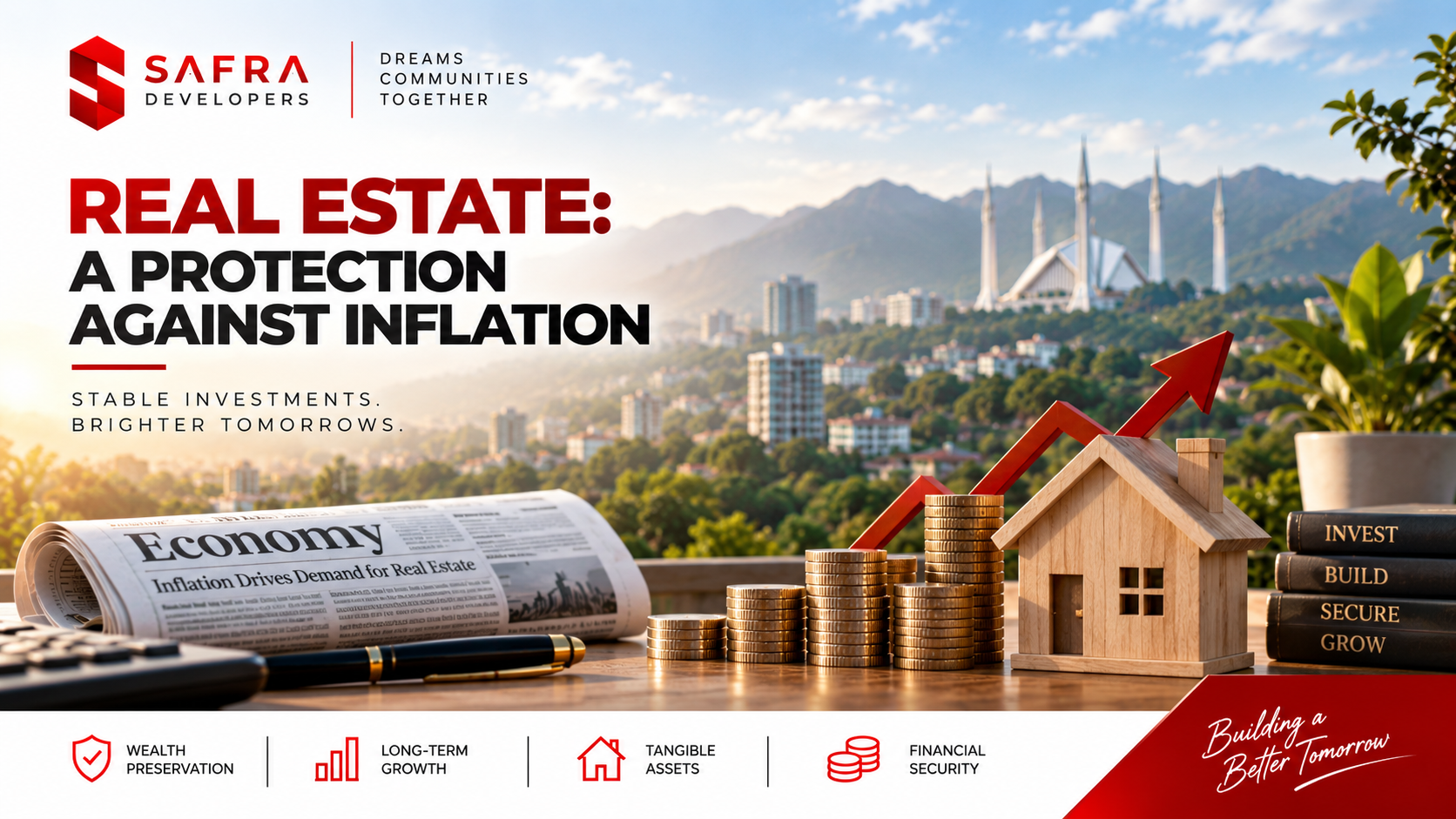
In today’s scenario, where there is constant inflation due to global market uncertainty and conflicts (such as the US-Iran war), the value of the Pakistani Rupee is experiencing devaluation. This causes a decrease in currency value, and to secure their savings, people tend to move towards non-currency assets. In Pakistan, one of the very popular modes for securing one's savings from overall inflation effects is to invest in real estate. But like all markets, real estate can also be affected by inflation and so, this article will allow you to understand the relationship between inflation, real estate and securing asset value.
Currency And Inflation
Inflation is used to describe an effect in which prices rise over time, reducing the quantity of goods and services that can be bought by a certain amount of money ( which is Rupees in terms of Pakistan) over a period of time. In other words, you lose the value of money over time. If you’re earning less interest on your savings than the rate of inflation, then you’re effectively losing purchasing power every year, even if the number in your account hasn’t changed.
In recent years, Pakistan has witnessed a very high rate of inflation, and this has led consumers to look for assets that can keep pace with or outpace rising prices, rather than keep their money in cash.
Real Estate As A Barrier Against Inflation
Many people, in times of crisis when inflation rates rise rapidly, move towards investing in real estate. This is because real estate has the ability to hold value, which currency can lose. There are several reasons for this value retention seen in the property market, which are explained below:
- Land is scarce but demand is increasing. As cities grow larger and more people migrate to urban areas, affordable housing demand becomes an even greater need. This causes property values to increase and so does the cost of living.
- Construction costs are rising, too. When inflation increases the cost of cement, steel and labor, it costs more to build new housing. This makes already-built property have more demand and value by comparison.
- Inflation tends to push up rental income. Rental income can increase with the cost of living instead of losing value as it ages. Most landlords increase the rent over time.
- Tangible Asset. Property is a physical asset, and unlike cash or even some financial instruments, it doesn’t just evaporate in value overnight. This provides a security that can be owned without the fear of being lost.
Features of Inflation-Resilient Property
When discussing that a property has the capability to secure investment value and resist inflation and currency devaluation, it is important to state that such a property has some characteristics. These characteristics provide it with the strength to hold value over years. Some of these characteristics are given below:
- Location matters most: A property in such an area that is undergoing infrastructure and population development is expected to have more rapid value appreciation than a fully developed, mature, and old area.
- The legal status matters: A property that is not approved by the relevant authority or may have ownership conflicts is risky, no matter how good the price looks.
- Actual demand counts: A property bought mainly for speculation, where there is little real interest from buyers or tenants, is not as good a hedge against inflation as a property that has strong demand fundamentals.
Property As A Source Of Rental Income
A lot of investors just look at the appreciation a property can have. In inflationary periods, rental income is also important, as it provides a regular stream of cash which can be used for any other investment or used to offset higher living costs, rather than waiting for a lump sum gain at resale in a few years.
Despite inflation and in times of economic crisis, real estate can hold its investment value. This is because land has always been scarce, increasing demand. Inflation where devalues currency, increases land cost, construction cost and living cost as a whole. The sense of security offered by property is the real win, which pushes many investors to invest in real estate to preserve their savings. Therefore, with all the right characteristics, real estate can act as a protection against inflation.