
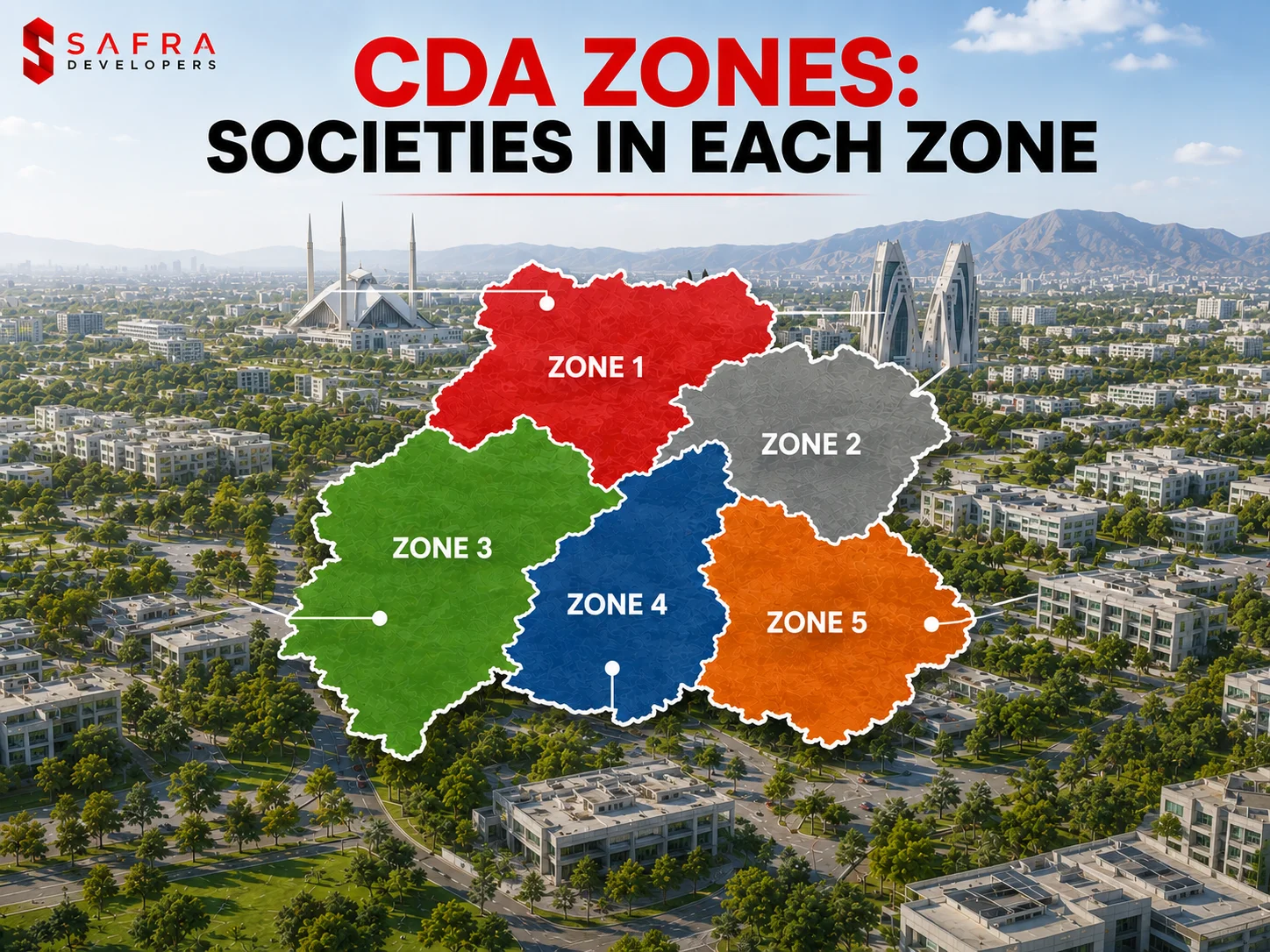
Islamabad’s real estate market can confuse new buyers due to its different zones, as property in the capital can have different legal value depending on the location of that property. CDA has divided the land of Islamabad into multiple zones, and a good understanding of these zones helps buyers and investors assess the legality of property in Islamabad. This article. Therefore, it will guide you to different zones and societies in each CDA zone.
What are CDA Zones?
The Islamabad Capital Territory (ICT) is divided into five zones under the ICT (Zoning) Regulations 1992. The zones are divided into different uses and have different rules regarding what can be built legally.
- Zone 1: Approximately 54,958 acres; the largest developed urban area. It includes established sectors such as the E, F, G, H, and I series
- Zone 2: Roughly 9,805 acres of a smaller urban zone, connected to Zone 1 and neighboring Rawalpindi.
- Zone 3: An extensive environmentally sensitive zone of approximately 50,393 acres, where construction is strictly controlled to preserve the Margalla Hills and other green spaces in the vicinity.
- Zone 4: The largest zone in total, opened to private and farm housing schemes only in 2010. It contains areas that are farther out from the heart of the city.
- Zone 5: Like Zone 2, this zone has been earmarked for private housing societies since 1992.
Need For CDA Zones
CDA introduced zoning to manage the growth and development in Islamabad, as it is Pakistan’s first planned city. Each zone is designated to serve a different purpose such as:
- Core urban sectors for the daily living of the city
- Environmentally sensitive areas that needed protection from heavy construction
- Specified areas where private developers could build housing societies under the CDA’s regulation and supervision.
Societies In Each CDA Zone
Zone 1-2
CDA directly manages the core sector system of Islamabad, which consists of Zone 1 and Zone 2 instead of private developers:
- E-sectors (E-7 to E-18) – Large plots, embassies & upscale residential development.
- F-sectors (F-6 to F-14): Developed central residential areas.
- G-sectors (G-5 to G-14): Mixed development of residential and institutional areas.
- H and I- sectors: Mix of residential, educational, and industrial areas.
Zone 5
Zone 5 has some of the most identifiable private housing societies of Islamabad, such as Bahria Town Islamabad, Gulberg Greens and Gulberg Residencia, Naval Anchorage, and CBR Town.
Zone 4
In 2010, CDA allowed the development of private housing societies in Zone 4 after development was being conducted at speed. Some famous societies in Zone 4 include many sectors and phases of DHA Islamabad and Park View City.
| Zone I | Zone II | Zone III | Zone IV | Zone V |
| A, B, C, D, E, F, G, H & I Sectors | Cabinet Division Employees Cooperative Housing Society | Margalla Hills / Margalla Hills National Park | Anza Zephyr Dale Agro Farms | AGOCHS Phase-I |
| F-5, F-6, F-7, F-8 | Engineers Housing Scheme | Protected / conservation areas | Bahria Enclave Phase-I | AGOCHS Phase-II |
| F-9, F-10, F-11 | Faisal Residential Housing Scheme | Recreational areas | Bahria Enclave-II Agro Farming Scheme | Al-Hamra Avenue |
| G-5, G-6, G-7, G-8 | Khayaban-e-Kashmir Phase-I | — | Bahria Enclave-II Phase-II | Al-Makkah City |
| G-9, G-10, G-11 | Khayaban-e-Kashmir Extension | — | Federal Government Employees Housing Foundation | Army Welfare Trust |
| H-8, H-9, H-10, H-11 | Margalla View Housing Scheme | — | FIA Park Enclave Housing Scheme | Bahria Garden City |
| H-12, H-13, H-14, H-15 | Margalla View Extension | — | Gulberg Greens Farm Housing Scheme | Bahria Town Phase II, III, V & VI |
| H-16, H-17 | Ministry of Interior Employees Cooperative Housing Society | — | Park View City Housing Scheme | Bahria Town Phase III-E/IV |
| I-8, I-9, I-10, I-11 | Multi Gardens Phase-I | — | Rahman Enclave Housing Scheme | Bahria Town Phase VII |
| I-12, I-13, I-14, I-15 | Multi Gardens Phase-II | — | Al-Hamra Hills Agro Farming Scheme | Bahria Town Phase VII-E |
| I-16, I-17 | National Police Foundation | — | Pakistan Navy Farms | Capital Enclave |
| E-7, E-8, E-9, E-11 | New Islamabad Garden | — | — | CBR Town |
| Diplomatic Enclave | Paradise City | — | — | Engineers Cooperative Housing Society |
| Blue Area / Central Business District | Roshan Pakistan Housing Scheme | — | — | Grace Valley |
| Constitution Avenue / Red Zone | Supreme Court Employees Housing Scheme | — | — | Gulberg Residencia |
| — | T&T Employees Cooperative Housing Society | — | — | Gulshan-e-Sehat |
| — | Tele Gardens Housing Scheme, F-17 | — | — | Islamabad Gardens |
| — | Federation of Employees Housing Scheme | — | — | Jeddah Town |
| — | — | — | — | Jinnah Garden Phase-I |
| — | — | — | — | Jinnah Garden Phase-I Extension |
| — | — | — | — | Jinnah Garden Phase-II |
| — | — | — | — | Jinnah Town |
| — | — | — | — | Kashmir Gardens Farming Scheme |
| — | — | — | — | Khayaban-e-Kashmir Phase-II |
| — | — | — | — | Morgah City |
| — | — | — | — | National Assembly Employees Cooperative Housing Society |
| — | — | — | — | National Cooperative Housing Society & New Islamabad Enclave |
| — | — | — | — | Naval Anchorage |
| — | — | — | — | OPF Housing Scheme |
| — | — | — | — | Parliamentarians Enclave |
| — | — | — | — | River Garden |
| — | — | — | — | Senate Avenue |
| — | — | — | — | Services Cooperative Housing Society |
| — | — | — | — | Soan Garden Housing Scheme |
| — | — | — | — | Tele Town |
| — | — | — | — | WWF Labour Colony |
| — | — | — | — | Zaraj Housing |
The zones developed by CDA have specific rules and regulations for the type of development allowed, which helps in city infrastructure management. These zones, with their set of rules, determine the legal status and value of the property.