
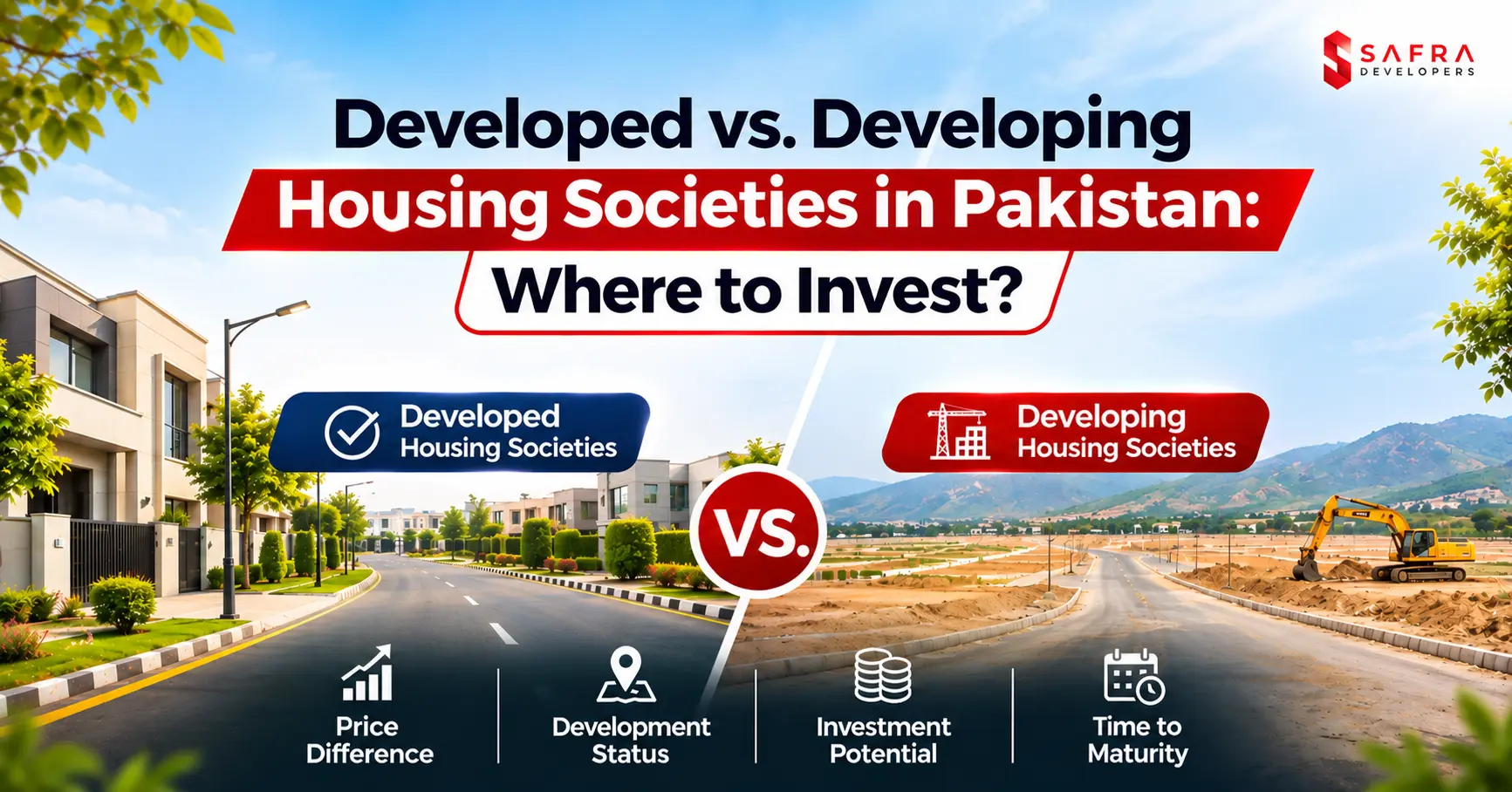
For anyone intending to purchase a property in Pakistan, they often encounter a small hurdle in deciding where to invest. Is a developed housing society a better option or a developing one? This can be an important decision as each of them has their own characteristics. The best decision is always the one that aligns with the investor's preferences.
This article will therefore discuss the characteristics of a developing and a developed housing society and provide a comparison between them to better display their best feature.
What is a Developing Housing Society?
Any such society that has its development and construction work underway can be termed a developing society. This development can include the installation of basic utilities, construction of the road network, as well as other residential, commercial, or recreational infrastructure that may be in the planning stage or under construction. Buyers with short-term plans tend to buy in well-developed projects, while those aiming to invest for a longer period may buy in developing societies.
Example: Saffron City Rawalpindi & DHA RVS
What is a Developed Housing Society?
A developed society is a community that has been established where basic utilities and infrastructure already function. Houses are going up, and families live in them. You can come and visit and have a look around and see what you think of it. With developed projects, you don’t have to wait for very long periods because everything is done for you.
Example: DHA Phase 2 Islamabad
Looking At The Present Picture
Look past the price and see what exists today. A developing society might have some exciting plans, but you need to be aware of the degree of development that has been done so far. In a developed society, you are able to determine the property that is being purchased. This means you need to conduct an analysis of whether the price is in accordance with the development done, or are you simply paying for future promises.
Lower Prices And Longer Waiting Periods
Developing housing projects can have lower prices in the initial stages, which makes them appealing, but waiting comes at a cost. For anyone investing in property do make a home may want a developed community quickly, and so a partially developed area may be a problem. The developing areas are said to be good for investors who can hold property for longer time periods, such as 4-7 years. It is also believed that rentals are for steady returns and lower risk, while capital gains are for those who can hold for several years.
Risks Involved
Developing projects are riskier. The risk is higher in the case of under-construction projects and in many cases in Pakistan there are multiple examples where developers did not deliver the promised development. There is also the question of fake societies. One of the red flags is missing legal documentation. Developed societies tend to be safer (but not without risk), but they are also accompanied by relatively higher prices.
Importance of Infrastructure and Road Networks
Roads, electricity, water, drainage, security and green spaces are the elements that define daily life in any society. In a developed society, you can check them yourself. In a developing one you often rely on plans, so ask which services are already in place and which are only promised.
Location is equally important. A community with good road links to your workplace, schools and hospitals saves you time every day and may be easier to sell later. A badly planned society on a good road can still be a hard place to live, so check the route as well as the plot.
Developing Vs. Developed Housing Societies: A Comparison
| Developed Society | Developing Society |
| Roads, utilities and facilities already working | Infrastructure under construction or planned |
| You can inspect the surroundings before buying | You rely on development plans and progress reports |
| Often higher entry price | Often lower entry price |
| Little or no waiting time | Possibly several years of waiting |
| Generally lower investment risk | Higher risk, including delivery risk |
| Steady rental income and shorter holding period | Potential capital gain over a long holding period (4–7 years) |
| Suitable for buyers planning to build soon, seeking lower risk, and overseas buyers | Suitable for patient investors willing to accept uncertainty |
| Verify NOC, ownership documents and additional costs | Verify NOC, construction progress and possession dates |
Thorough Verification
It is important to verify important details of the project, whether developing or developed.
• Legality: Invest in a society that has a No Objection Certificate (NOC) from the concerned authority.
• Development status: Check out the site and see what's built vs. what's promised.
• Location: Check road access to work, schools, and hospitals.
* Paperwork and costs: Review ownership documents, payment terms, possession dates, and extra charges.
Which Is Better: Developed Or Developing Housing Society?
There is no one answer to this question, as it all depends on the investor's preferences.
- Developing housing projects are ideal if you can wait a few years, can tolerate more uncertainty, and want a lower entry price.
- Developed housing projects are best suited if you are building soon, want less risk, or are buying from overseas and can’t visit
Developed housing societies have visible advancement with lower risk, while developing housing societies provide a good investment opportunity at a low-cost entry and excellent growth opportunities for weary investors; your choice would be based on many factors, such as money, timeline, and risk tolerance. Start by checking for construction permits, determining if a visit to the site can be made, and evaluating the available investment options.