
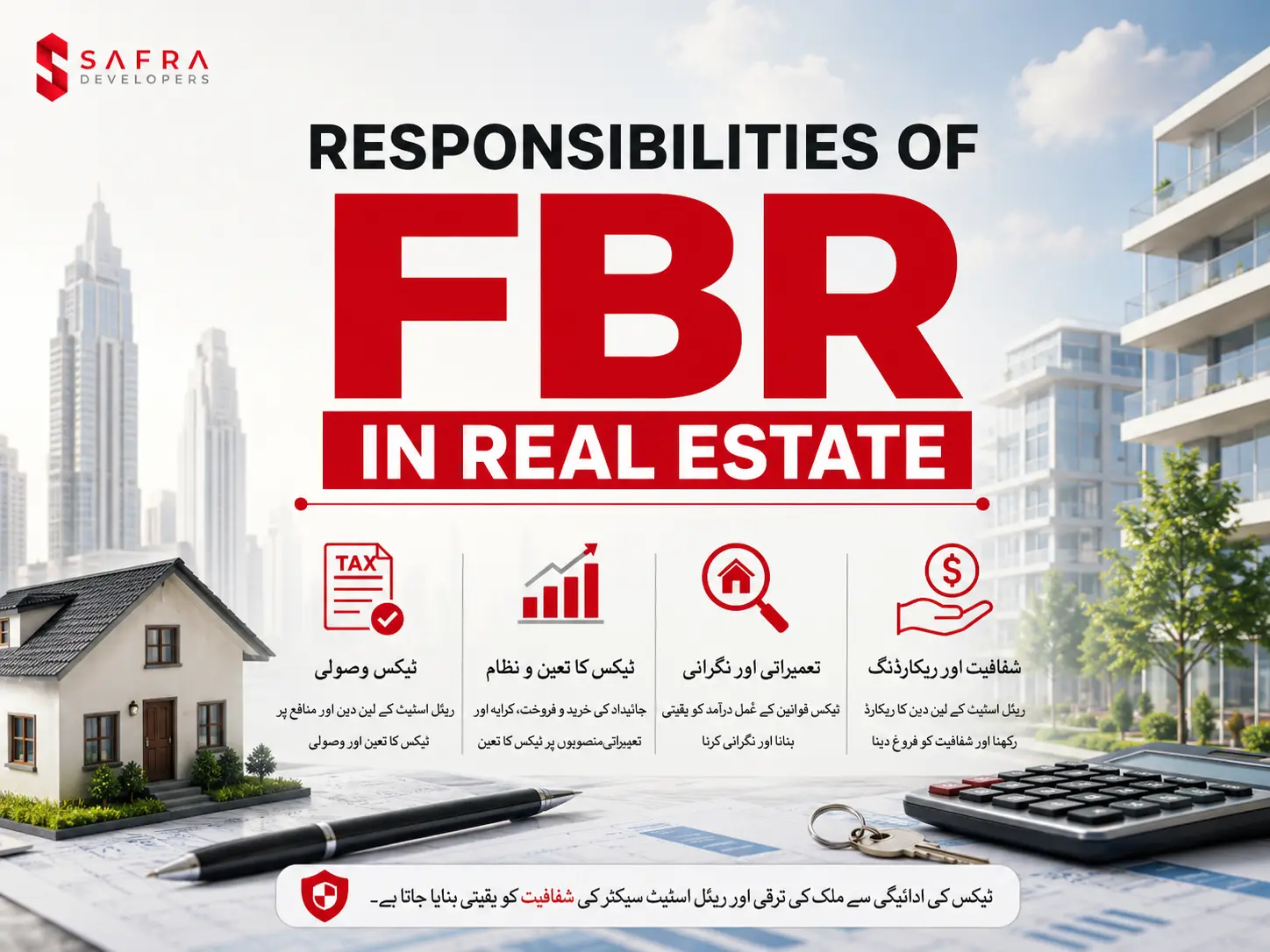
Real estate has always been an important sector, as it accounts for a massive share of the country’s GDP, is a major sink for foreign and local investment, and provides employment to thousands of people. Despite its scale, this sector has remained undocumented and unmonitored, leading to loopholes in tax collection and property scams.
FBR is a government body with multiple functions, primarily revenue generation through taxes and enforcement of financial rules and regulations. FBR has been strictly operating to convert real estate into the formal sector of Pakistan.
What is FBR?
FBR, which stands for Federal Board of Revenue, is a government body that operates under the Ministry of Finance. Its headquarter is located in Islamabad. It is the major body managing the revenue generation and documentation in the economic sectors. It has the following main responsibilities:
1- Tax and Revenue Collection
FBR collects different types of taxes, which can be categorized as
- Direct taxes in the form of income tax.
- Indirect taxes in the form of sales tax and the FED.
- Custom duties in the form of tariffs on the import and export of goods.
2- Documentation:
FBR is responsible for converting the cash-based economy of Pakistan into document based. They do this by maintaining lists and documents and fines on informal transactions.
3- Dealing with Financial Crimes:
FBR controls tax thefts and monetary frauds by investigating itself or as a result of any complaint. Once a crime is proved, they have the authority to punish the criminal according to the law.
4- Handling Custom Matters:
FBR also operates on borders. FBR has its Pakistan Customs Wing, which monitors all goods being imported and exported to curb the smuggling issue.
5- Tax Policies:
FBR is also responsible for creating new tax-related policies and the framework for implementation, which they submit to the government for approval.
FBR Valuation
FBR collects different types of taxes on properties, which account for a significant portion of annual revenue. For this tax collection, FBR needs a threshold for each property type based on which tax can be collected. This threshold also needs to be a standard value to ensure transparency in the process. For this purpose, FBR maintains its own standard values for each type of property, which are regularly updated for each area.
In Pakistan, the value of immovable property is determined through three main valuation systems. These systems are:
- Market Value: It is the actual price at which a property is bought or sold in the open market. This value is determined by market factors such as supply, demand, inflation, etc.
- DC Value: This is the value of a property set by the Deputy Commissioner (DC) of the area. It is the lowest possible value of the property and is used for provincial tax collection.
- FBR Value: This is the value of the property set by FBR for federal tax collection.
The FBR values are slightly higher than the DC value but are lower than the market values. The reason for this is that the very low DC values created a loophole in which property owners would pay less tax for a property. To cover this problem, the gap between DC values and market values was moderated through FBR values.
| Valuation Type | Who Sets It? | Main Purpose | Price Level |
| DC Value | Provincial Government | Used for Stamp Duty & Registration | Lowest |
| FBR Value | Federal Board of Revenue | Used for Federal Taxes (236K/236C) | Medium |
| Market Value | Real Estate Market | Actual buying & selling price | Highest |
Taxes Collected by FBR
| Tax Type | Definition | Key Details |
| Capital Gains Tax (CGT) | Tax on profit earned from selling property. | Flat 15% rate for new properties. |
| Advance Income Tax on Purchase (Section 236K) | Tax paid by the buyer when purchasing property. | Based on the FBR/DC value, non-filers pay more. |
| Advance Income Tax on Sale (Section 236C) | Tax paid by the seller at the time of sale. | Deducted during property transfer. |
| Capital Value Tax (CVT) | Tax on transfer of immovable property. | Usually 2% of property value. |
| Federal Excise Duty (FED) | Tax on first transfer of properties in housing projects. | Applies mainly to new residential and commercial projects. |
| Section 7E – Deemed Income Tax | Tax on deemed income from held property. | Applies even if property is not rented out. |
Tax Documentation
FBR carries out documentation of economy by following methods:
ATL List: FBR maintains a list of Active Tax Payers (ATL). It classifies citizens on the basis of their tax return status. On basis of this it maintains three categories:
- Filers: Those who file annual tax returns within the deadline
- Late-filers: Those who file annual tax returns after the deadline
- Non-filers: Those who do not file their annual tax returns
NTN: The tax payers are issued a specific ID by FBR through which they are identified in the tax system.
Anti-Money Laundering
Apart from revenue generation, FBR has a more active role in anti-money laundering (AML) efforts and Countering the Financing of Terrorism (CFT) related to real estate. This action is carried out under the requirements of the Financial Action Task Force (FATF) framework.
Some of the most important steps taken by FBR includes the following:
- Deceleration of Source: FBR has set a threshold value beyond which property purchases need to be justified by declaring the source of money for those purchases.
- DNFBP Registration: Property dealers and agents are categorized as "Designated Non-Financial Businesses and Professions" (DNFBPs). They are legally required to perform customer due diligence and report cash transactions greater PKR 2 million to the FBR.
- Integration and Digitalization: The FBR is linking property records with NADRA and provincial land authorities to improve ownership tracking and verify the source of funds.
- Benami Transactions: There is an ongoing crackdown on properties registered in the names of third parties to conceal actual ownership.
FBR, being the main government body for tax and revenue collection, is undergoing many reforms to digitalize its processes and minimize money laundering and corrupt practices in multiple sectors. With the current pace at which innovation is being adopted in the department, FBR is expected to become a highly well-managed and documented institution in Pakistan.