
Listen to Brief Podcast on Green Property Certificate
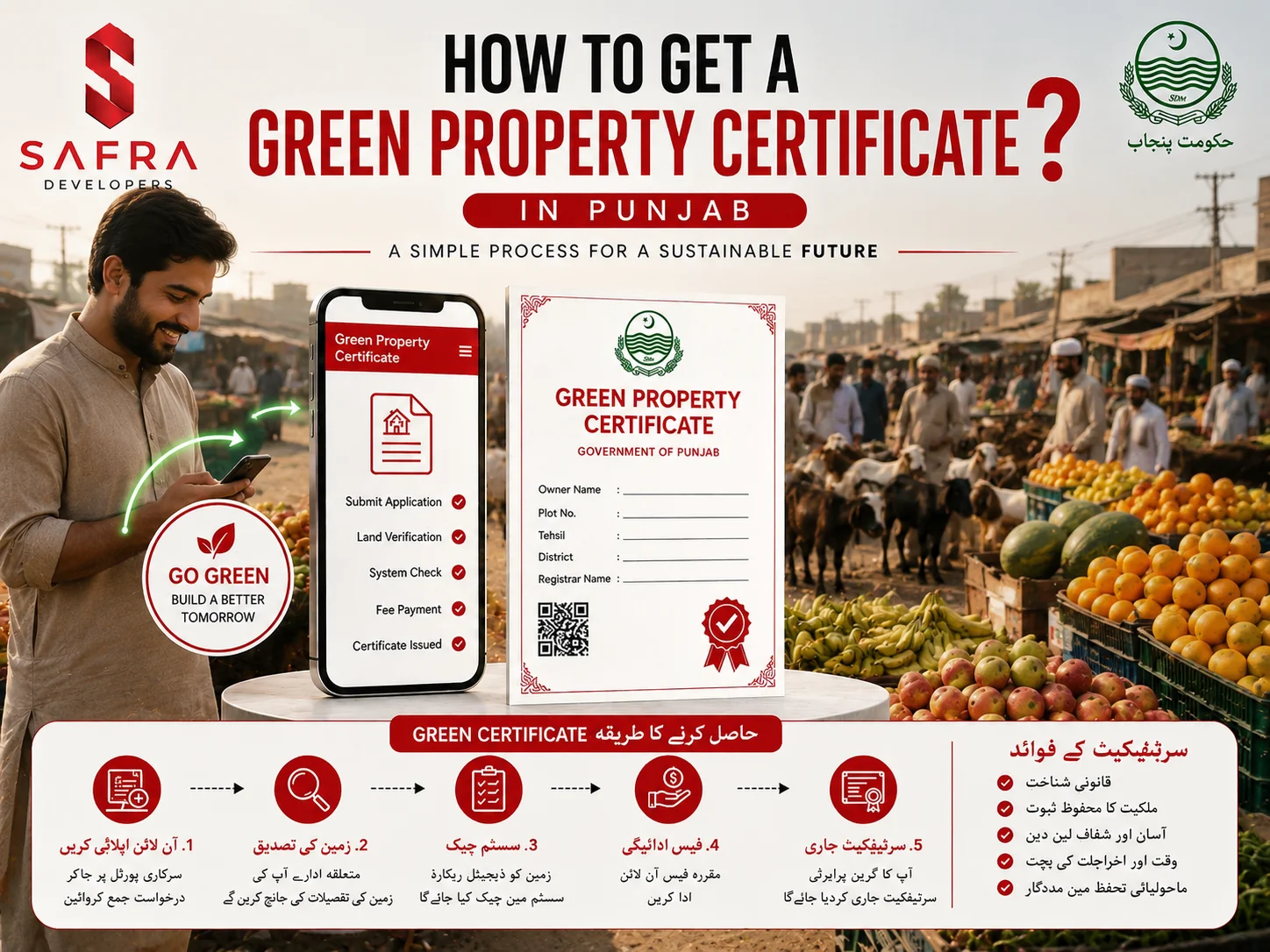
The government of Punjab is bringing massive reform to the property market and record system. Among these, one is the introduction of the green property certificate. This document aims to improve record management and reduce fraud in property transfers by increasing system transparency. By the end of 2026, the entire province of Punjab will have to get a green property certificate for its property transactions.
But the question is, “How to get a green property certificate in Punjab?” This article will provide you with all the essential steps to obtain a green property certificate.
Green Property Certificate
The Punjab Government used to issue Fard as an official document for ownership verification. However, Fard only lists the ownership status and basic property details. Therefore, the Fard is being replaced by a green property certificate in Punjab to provide a digital document containing detailed information about the owner and the property. This certificate provides information on
- The legality of the property and any associated disputes
- The authenticity of the owner
- The actual possessor of the property
- The property details
How To Get A Green Property Certificate
The process to obtain a green property certificate is a bit lengthy due to high-level verifications and has about 10 steps. Each step has been explained in detail below:
Visiting the Araazi Record Center (ARC)
Despite the GPC being a digital document, you will have to visit a nearby Araazi Record Center (ARC) in your area. You will have to reach out to the counter and inform the staff that you are here for a green property certificate. Upon this, the staff will issue you a token number and will advise you to wait for your turn.
Providing Required Details and Fee Submission
The staff will call you on your turn, where you will be asked to provide relevant details such as your CNIC, Fard, or Registry of property, and your contact details. After providing details, you will also have to pay the processing fee, after which the details will be processed and verified. The fee is about 950Rs and can be paid through Bank of Punjab or through online transfer.
Verifying Your Identity
The staff will then run your CNIC in the NADRA system to verify your personal details, such as your name, family details, contact details, etc. A biometric verification will also be carried out with the NADRA’s database.
History Check
The data from the Punjab Land Record Authority (PLRA) is used to carry out a background check for the property. The staff determines if any past transactions were carried out legally, all taxes and dues are cleared, and there are no disputes related to the concerned property.
Field Survey
Previously, ownership verification documents were issued by simply providing details, followed by online verification. The GPC, along with online verification, requires a field visit for verification as well. The staff visits the property and measures the boundaries using GPS to ensure the accurate land size of the property.
Neighbour Verification
The statements of two neighbours are required to determine the possession of the property. These two neighbours will have to be registered in the land records and have to provide biometric verification. Through this step, the GPC provides data on actual possession of property.
Verification by Supervisor
Once the data has been verified through online and site visits, a supervisor, who is often a government officer of grade 17, looks into everything and verifies all information and determines the transparency of the entire procedure.
Public Notice
The PLRA on their official website put up a notice for a period of 15 days to consider any objections from the public. If no objections are raised in 15 days the process is moved to the next step
Approval
Once the entire process is complete, the Assistant Director Land Records (ADLR) reviews the entire process conducted from the start to the audit and reports generated. This provides a two-step review to the process adding transparency to the system. After the review the ADLR then approve the grant of the certificate.
Certificate Issuance
After the certificate is approved by ADLR, the fard and other conventional documents are then replaced by the green property certificate issued to the owner. This certificate has a QR code which connects ith digitally to the land records system.
The process to obtain a Green Property Certificate in Punjab is although a long process but double verifications and site visits add transparency and accuracy to the property management systems. This new document can prevent property scams and allows better property transactions. This step is expected to boost the investor confidence and uplift the local real estate market.