

Who is a Tax Filer
A tax Filer, in the Pakistani tax system, refers to a citizen who submits their income tax returns on an annual basis via an NTN ( National Tax Number). A person cannot be entitled as a filer if he pays tax but not on an annual basis, even though he has been allotted an NTN and so is not present in ATL. This characteristic distinguishes filers from non-filers.
For a beginner, understanding filers and non-filers, associated conditions, and privileges requires basic knowledge of some commonly used terms.
Some of them have been described below:
Difference Between a Filer and Non Filer
Filer, as discussed above, is the one enlisted in ATL, and so non filer does not submit annual income tax returns and has no presence in ATL. Such a person or business may not be paying any tax, or periodic tax returns may be missing. The Government of Pakistan has developed policies to favor the former while penalizing the latter.
Privileges for Filer
Enlisting in the annual ATL affirms the economic activities to be carried out by the filer as legal and law-abiding. As a result, they can avoid heavy withholding taxes and deductions on cash withdrawal from bank accounts. They can also enjoy comparatively lower taxes on property buying and sales. They enjoy vast varieties of investment opportunities.
Demerits of Non-Filer
Non-filers have to pay higher withholding taxes, about 2-3 times higher than filers. High tax rates in different sectors, such as cash withdrawal, property transactions, and investments as a form of penalty for not being included in the tax net. Apart from heavy WTH, they also face restrictions on the above-mentioned activities beyond a certain baseline. They can also become susceptible to FBR audits.
How to Become a Tax Filer in Pakistan
In order to register oneself as a filer, one should be able to produce a CNIC, a SIM number, an email address, along with incomeand bank details.
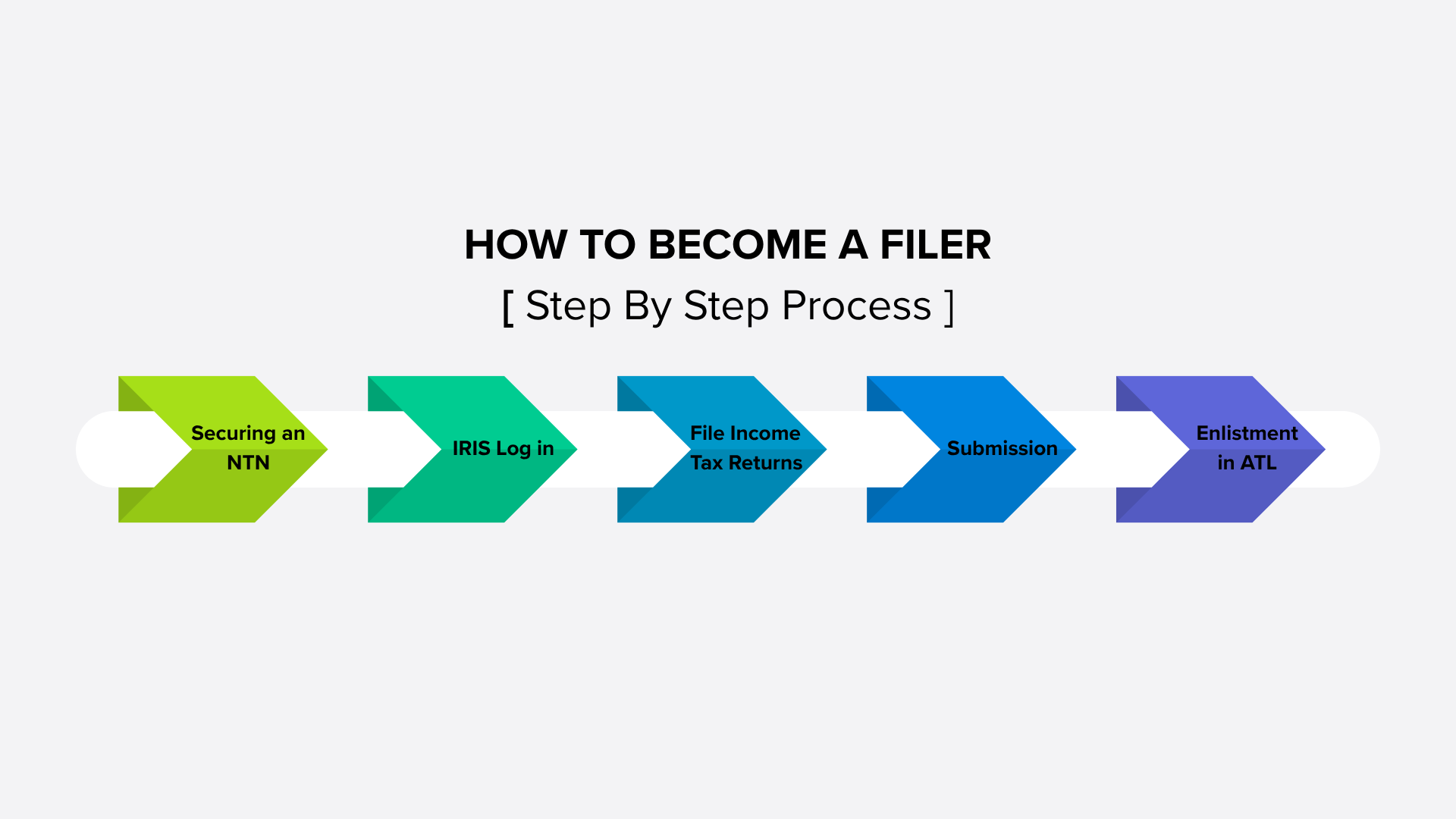
Some basic steps guiding on how to become a taxfiler in Pakistan have been discussed as follows:
1- Securing an NTN
NTN provides a tax ID through registration in FBR. For this, FBR has established an online portal with the term IRIS (www.iris.fbr.govt.pk) from where an NTN can be obtained. For this, one needs to go to IRIS and fill out a submission form by clicking on registration of an unregistered person. Here, details such as CNIC, phone number, and email address are to be provided, after which verification via an OTP on the provided contact information can occur. Once the submission is complete and registration is successful, the taxpayer's CNIC is assigned the NTN status. For businesses and firms, an NTN is issued separately.
2- IRIS Log in
Once the registration is complete, the taxpayer is provided with an NTN and a password, which can be used to log into the IRIS portal. Access to IRIS is required to file tax returns.
3- Filing Income Tax Returns
Once logged in to IRIS, income details are to be provided through forms relevant to their source of income. There are 4 forms for each broad income source; the taxpayer can select the one applicable.
These forms include:
- A form for the salaried people
- A form for business persons
- A form for people earning through freelancing
- A form for people whose income comes from renting properties.
where the mentioned income source comprises more than 50% of the total income. Along with this, a wealth statement needs to be submitted, providing details of assets such as property, vehicle, bank balance, investments, loans, and debts.
4- Submission
Once the form for the tax return has been filled out and all required information has been provided, the form is to be submitted on the IRIS portal. The form is then processed, and on the grounds of available data te tax to be paid is calculated. This tax amount, when paid, results in the generation of a receipt that can be saved and used as evidence of payment.
5- Enlistment in ATL
This is the final step, which involves verifying one's name in the ATL. This confirms that the taxpayer has been granted the status of an active filer after fulfilling all requirements and, therefore, is legally entitled to the benefits enjoyed by a filer.
Enlistment in ATL can be checked through the FBR online portal or their mobile app. Also, the status can be determined through an SMS service.
If an individual or business is not able to file their annual income tax return within the deadline issued, and submits later on, their status is upgraded to a late filer after the payment of a surcharge. A late filer still gets penalized through heavy taxes. A late filer has a status in between an active filer and non filer in terms that they have restrictions and tax enforcements however, comparatively lower than a non-filer.
Becoming a filer in Pakistan has never been this easy. Simple steps, including acquiring an NTN number, using that NTN to prepare a tax profile where details related to income and assets are provided, followed by enlistment in the ATL. This is a vital step for any taxpayer to declare themselves as law-abiding and tax-paying citizen which legalizes their economic activity. Through this, they are also able to enjoy the privileges provided by the Pakistani government related to commercial and monetary events.