
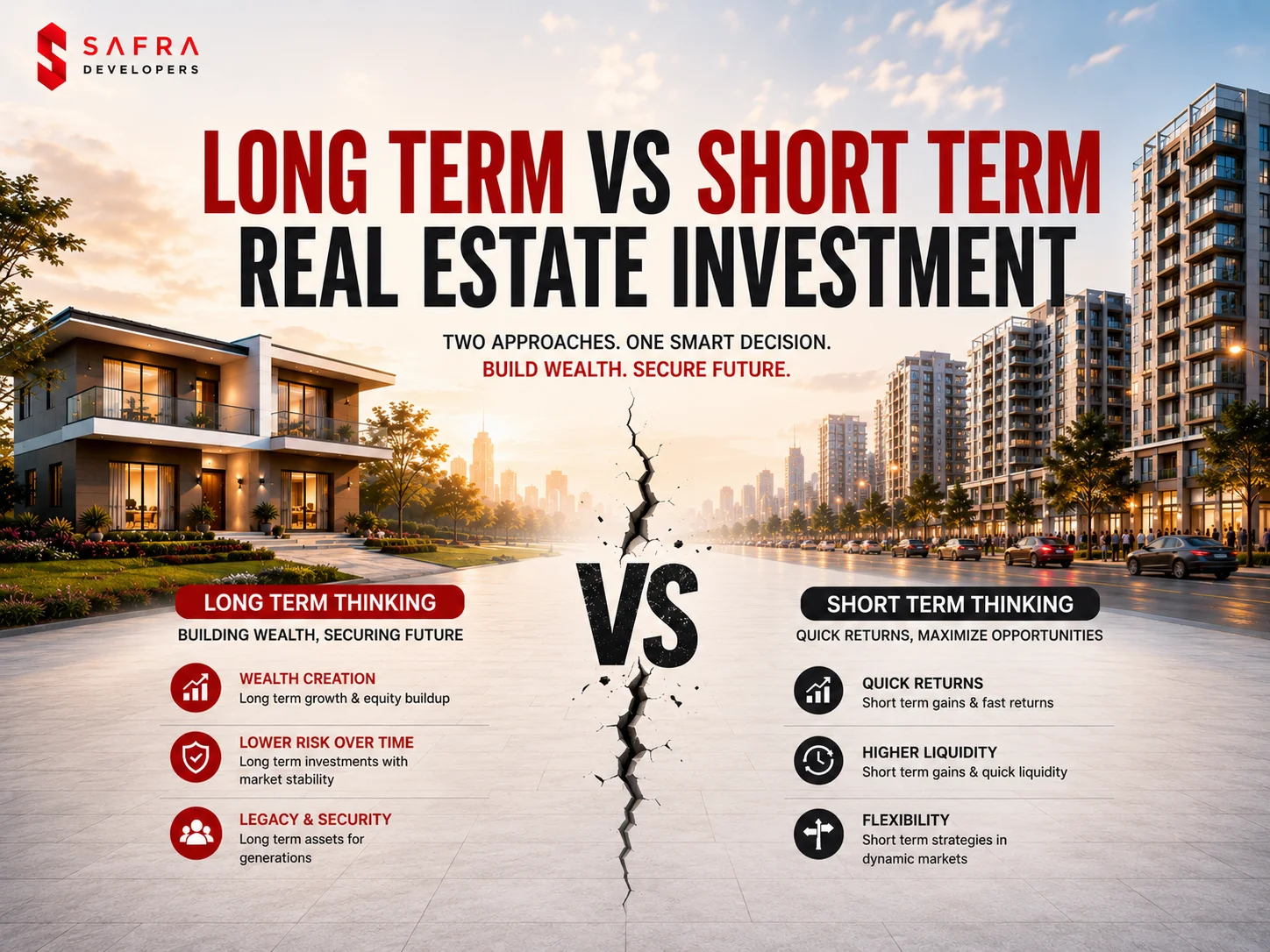
Real estate is one of the most popular investment options which often result in profit. But the type of investment also determines the nature of the profit. In real estate, two common investment strategies used include long-term vs short-term investment. Both approaches have very different goals, budgets, and risk levels. This article elaborates on the features of long-term vs short-term investment strategies to allow you to determine the best strategy for you.
What Is Long-Term Real Estate Investment?
Long-term investing means buying a property and holding onto it for several years, often 5, 10, or even 20 years or more before selling. The goal of this strategy is steady, gradual growth rather than a quick win.
Long-Term Real Estate Investment Strategies
- Buying a plot in a growing housing society and waiting for the area to develop:
- In this strategy the property is purchased early, before roads and utilities are fully built, and so, the area's natural growth increases the plot's value over the years.
- Purchasing a house or apartment to rent out for ongoing income:
- This strategy allows earning monthly rental income while also benefiting from the property's value slowly increasing.
- Buying land in an up-and-coming area before major infrastructure develops:
- Although this strategy looks similar to the first one, it is different as it is focused around a main infrastructure or development project. For example, land near a planned highway, ring road, or new commercial zone, where the eventual construction typically drives prices up significantly once it's completed.
- Holding commercial property for steady, long-term rental income:
- Here shops, offices, or small plazas are rented out to businesses, which often provide higher and more stable rental returns than residential property.
Advantages of Long-Term Real Estate Investment
- Lower risk:
- Since there is no rushing to sell, so short-term market dips matter less.
- Compounding value:
- As infrastructure, schools, and commercial areas develop nearby, property values tend to rise steadily over time.
- Rental income along the way:
- Many long-term investors earn monthly rent while they wait for the property's value to grow.
- Better for retirement or family wealth planning:
- Long-term property is often used as a stable asset to pass down or rely on later in life.
Disadvantages of Long-Term Real Estate Investment
- Money is tied up for years, reducing flexibility if you need cash urgently
- Development in the area might be slower than expected, delaying price growth
- Ongoing costs like property tax and maintenance add up over time
What Is Short-Term Real Estate Investment?
Short-term investing often involves buying a property with the goal of selling it relatively quickly within a period of anywhere from a few months to a couple of years (usually 1-3 years) for a profit.
Short-Term Real Estate Investment Strategies
- Pre-launch plot buying:
- The developers typically offer their lowest prices before a project is officially announced, and prices often jump noticeably once the launch happens and public demand kicks in. In such a situation, investors purchase land at lower rates to sell them later on when prices increase.
- Renovate and resell (flipping):
- This is the classic "flipping" approach, where the profit comes from the improvements you make rather than from waiting for the market to grow on its own. An old property is purchased, renovated and then sold at a high price.
- Buying ahead of infrastructure news:
- In this strategy, investors try to buy in ahead of the news, since property near new infrastructure projects often sees a quick spike in value once construction is confirmed or completed, which can later on be sold at good profit.
- Short-term rental strategies:
- In this strategy, instead of a traditional long-term tenant, the property is rented out for short stays at higher nightly rates, which can generate quicker returns, especially in high-tourist-traffic locations, such as Air Bnbs.
Advantages of Short-Term Real Estate Investment
- Faster returns:
- There is no need to wait years to see a profit.
- Takes advantage of pre-launch pricing:
- New societies often see sharp price increases shortly after launch, which short-term investors try to capture.
- More flexibility:
- The money isn't tied up for a long period, so the money can be reinvested elsewhere sooner.
Disadvantages of Short-Term Real Estate Investment
- Market timing is hard because if prices don't rise as quickly as expected, investors could be stuck holding the property longer than planned
- Selling too soon in some cases can trigger higher capital gains tax compared to holding longer
- Pre-launch and speculative projects sometimes face delays, legal issues, or stalled development, which can trap investor’s money
| Factor | Long-Term Investment | Short-Term Investment |
|---|---|---|
| Time Horizon | 5+ years | Months to 2 years |
| Risk Level | Generally lower | Generally higher |
| Effort Required | Less active management | More active buying and selling |
| Income Type | Steady appreciation and rental income | Quick capital gains |
| Best Suited For | Retirement planning, family wealth, and passive investors | Active investors comfortable with market timing |
| Market Sensitivity | Less affected by short-term market dips | Highly affected by short-term market swings |
Both longterm and shortterm investment strategies provide different outcomes in terms of profit and time period. Where long-term investment allows long durations of holding with steady profit generation, short-term investment allows quick profit generation within a short period. The ideal strategy to be used however is dependent on the investor preferences.