
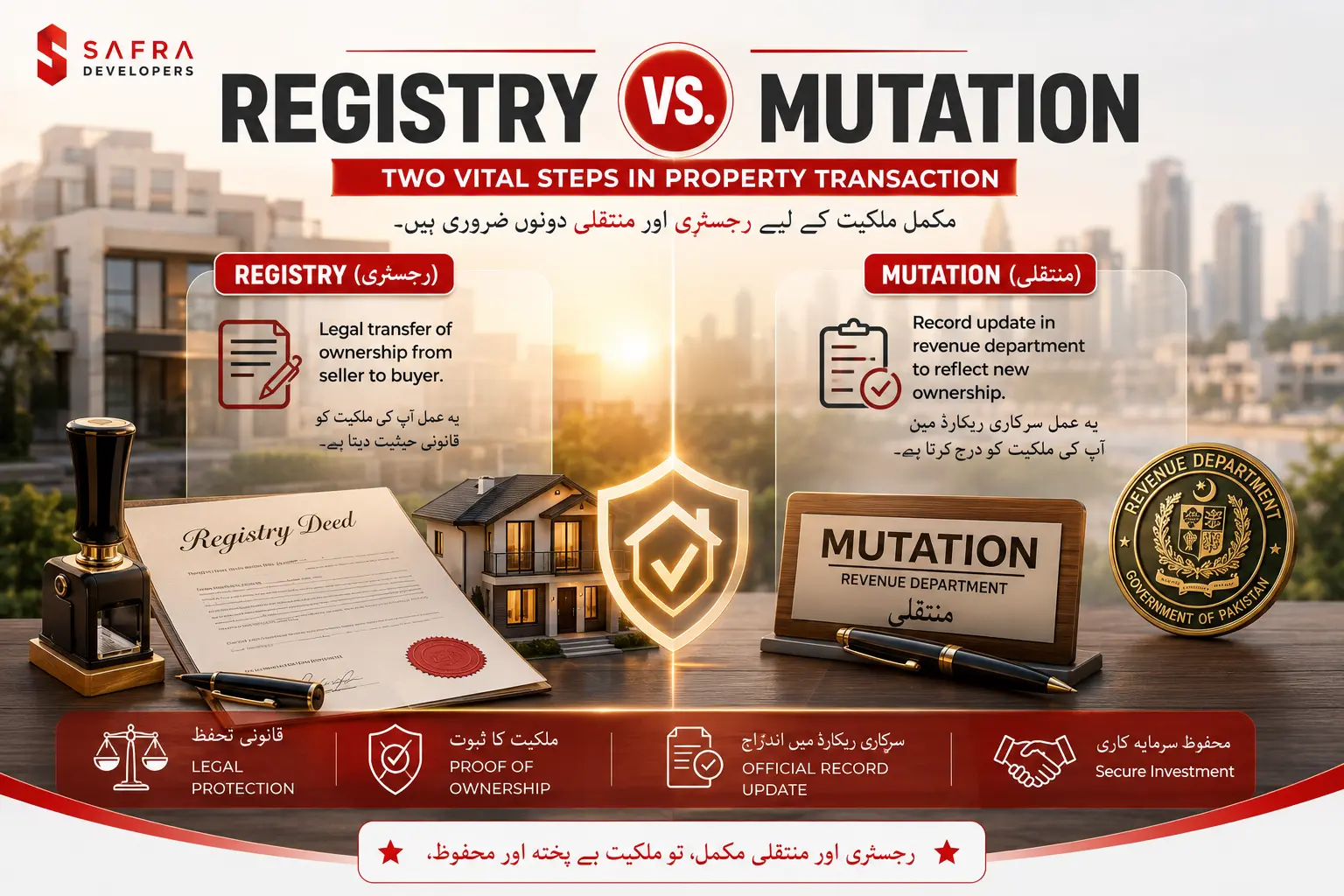
In real estate, several terms and conditions are involved when a property is sold and bought. Such important terms include registry and mutation which are often mistaken by many people as one single term with different names. This article will explain the differences between these two terms so that investors and home buyers are well-aware of every step in the transaction process.
Property Registry
The property registry is the official sale agreement between a buyer and seller before a government-appointed Sub Registrar. The registry is the document where the property rights are transferred from the seller to the buyer. This agreement has legal value and is admissible in court, with only the courts having the authority to cancel a registry.
Issuing Body
The registry is issued by the Sub-Registrar's office, which comes under the district administration and the Board of Revenue at the provincial level. There is a Sub-Registrar's office present in every tehsil across Pakistan.
Contents of Property Registry
A registered Sale Deed contains:
- Full names, CNIC numbers, and addresses of the buyer and seller
- Complete property description — location, plot number, khasra number (where applicable), size, and boundaries
- The declared sale price
- Date of transaction
- Signatures of both parties and two adult witnesses
- Stamp of the Sub-Registrar confirming registration
- Unique registration number entered in the official register
Property Registration Process
The registration process involves a series of steps, which are explained below:
1- Creating Sale Deed: A sale agreement is made between both the buying and selling parties, with all property details, transfer terms, and conditions mentioned
2- Payments: During the registration process, government taxes on property transfer, along with registration fees, need to be paid. The following taxes and payments are essential in the process:
- Stamp Duty
- Capital Value Tax
- Advanced Income Tax
- Federal Excise Duty (FED)
- Sub-Registrar’s registration fee
3- Verification: The Sub-Registrar verifies all associated documents
4- Registry Issuance: Once the verification of all documents is done, along with the required payments made, the registry is then handed over to the buyer, officially giving him the property rights.
Inteqal or Mutation
Inteqal or Mutation refers to the process by which the administrative land record of the government is updated to show the new owner of the property after the property transaction.
The government maintains a revenue record, which is based on the Revenue Department containing Patwari, Tehsildar, and provincial land records authorities like PLRA (Punjab Land Records Authority). Until the mutation is carried out, you may have become the new owner of the property, but the records would still be showing the previous owner as the holder.
Issuing Body
Inteqal is processed through the Revenue Department, specifically the Patwari (village-level revenue official), countersigned by the Tehsildar (sub-district revenue officer). In Punjab, the process has been modernised through PLRA's Arazi Record Centres (ARCs), through which mutation is now done digitally with biometric NADRA verification.
Mutation Process
The following steps are involved when mutating a property
- Request for Mutation: An application needs to be submitted to the land revenue office.
- Verification: The land revenue officer, also known as patwaris, verifies the documents provided to them.
- Updating Records: Once the verification is complete, the land revenue records are updated with the new owner of the property.
Registry vs Mutation
| Comparison Factor | Registry (Sale Deed) | Mutation / Inteqal |
|---|---|---|
| Governing Law | Registration Act 1908 | Land Revenue Act 1967 |
| Definition | Official legal document recording the transfer of property ownership from seller to buyer, registered before the Sub-Registrar. | Official update of government land revenue records (Jamabandi) to reflect the new owner's name after a transfer. |
| Purpose | Records and proves that a sale transaction took place between two parties. | Ensures government officially recognizes the new owner in revenue and administrative records. |
| Applicable Laws | Registration Act 1908, Stamp Act 1899 | Land Revenue Act 1967, West Pakistan Land Revenue Rules 1968 |
| Issuing Authority | Sub-Registrar's Office (District/Tehsil level) under the Board of Revenue | Patwari → Tehsildar or PLRA Arazi Record Centre (Punjab) |
| Record System Updated | Registration Register maintained by the Sub-Registrar | Jamabandi (Land Revenue Record) is maintained by the Revenue Department |
| When It Is Done | At the time of sale, before possession is transferred | After transfer through sale, gift, inheritance, court order, exchange, or partition |
| Applies To | Property sales only | All ownership transfers, including sale, gift (Hiba), inheritance, court decree, exchange, and partition |
| Documents Required | Sale Deed on stamp paper, CNICs of buyer and seller, fresh Fard, paid tax challans, two witnesses | Registered Sale Deed, CNICs of buyer and seller, fresh Fard, mutation fee receipt, two witnesses (where required) |
| Fees & Taxes | Stamp Duty (1–3%), CVT (2% of FBR value), Withholding Tax (236C & 236K), FED (5% residential / 2% commercial on first transfer), Sub-Registrar fee (typically 7–12% of property value) | Nominal mutation fee payable at the Arazi Record Centre or Tehsil Office |
| Cost Level | Relatively High | Minimal |
| Biometric Verification | Yes, NADRA biometric verification of buyer and seller is mandatory | Yes, NADRA biometric verification is generally required |
| Witness Requirement | Two adult witnesses with original CNICs must appear before the Sub-Registrar | Buyer, seller, and witnesses may be required, depending on provincial rules |
| Processing Time | 7–14 working days | 7–10 working days in Punjab (digital system); longer in manual systems |
| Output Document | Registered Sale Deed with registration number and official seal | Mutation (Inteqal) Certificate and updated Fard showing the new owner's name |
| What It Does Not Do | Does not update Jamabandi or revenue records automatically | Does not itself prove a legal sale; it must be based on a valid transfer document |
| Risk If Skipped | Transfer becomes legally unenforceable and may not be recognized by courts | The old owner remains in the revenue records, creating risks of disputes, double sales, and resale complications |
| Online Availability | e-Registration available in Punjab; partial availability in Sindh | Online mutation available in Punjab through PLRA; overseas applications also supported |
| Sequence in Property Transfer | Must be completed first and forms the basis for Inteqal | Completed after the Registry using the registered Sale Deed |
Both registry and mutation are important steps of property transfer. Although they are often used interchangeably, they are two distinct terms. A registry is the official sales deed recognized by courts, while mutation is the process to convert the new owner into the government's land record systems. Failing to complete any one process can create discrepancies in property transfer.