
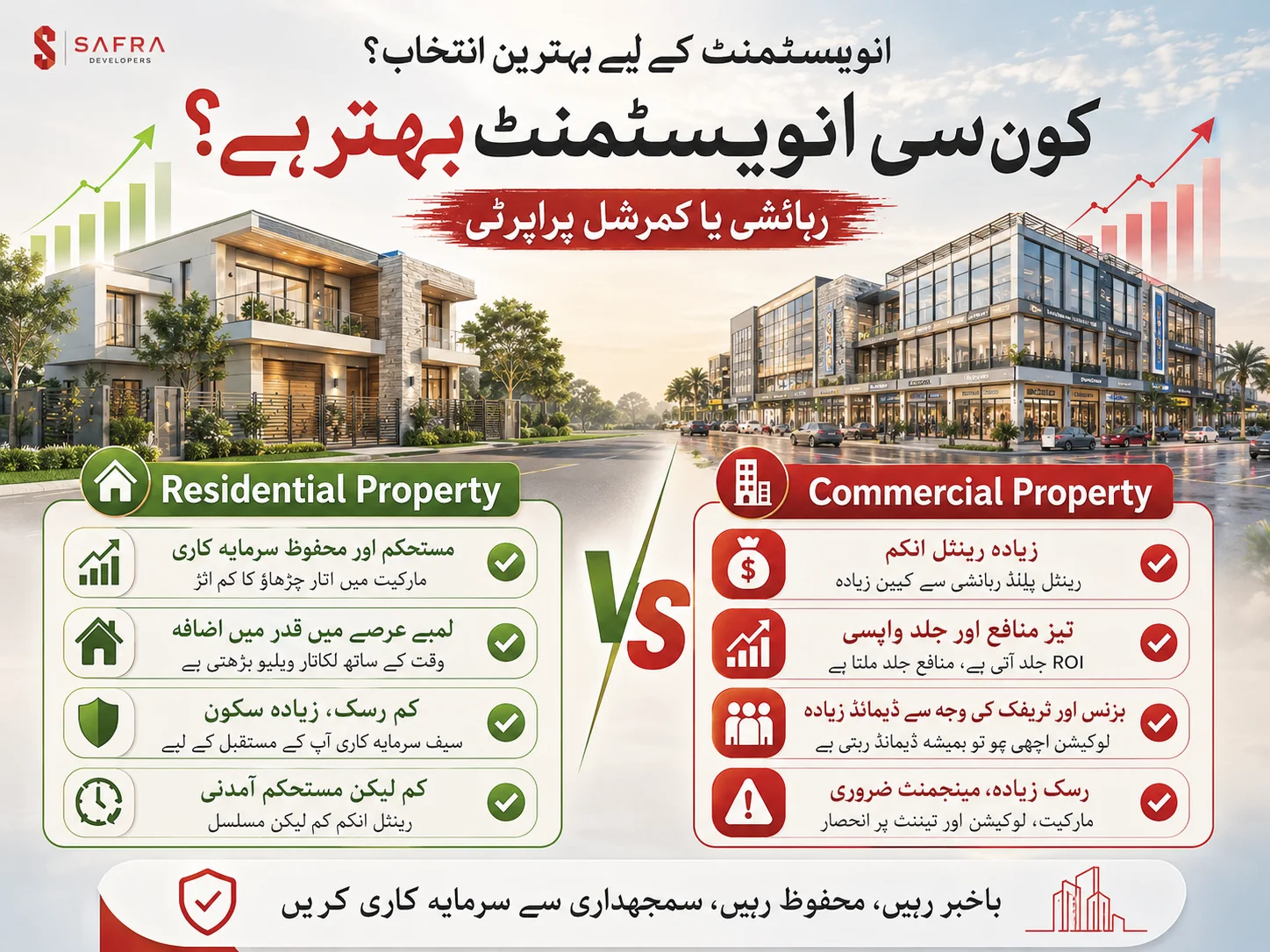
Whether to invest capital or secure your money value, real estate has always been a promising sector with high profits and ever-growing urban needs. Despite its attractiveness and growth over the years, the risk cannot be ruled out. Knowing where to invest for maximum benefit in available resources, or in residential property, or commercial property, is most suitable.
This blog will discuss details of residential and commercial properties, their characteristics, and the conditions that make each of them suitable according to investor or buyer preferences.
Commercial Property
Commercial Property is used by businesses and service providers or large residential buildings providing large revenue. They are of many types depending on the scale and business type.
- Residential Use: Such property involves buildings with apartments rented and maintained to generate revenue with 5 or more than 5 housing units.
- Retail use: Such property use involves exchange of goods and money and include stores, malls, shops, restaurants etc.
- Industrial Use: Such property use involves the production and supply of goods and products and includes factories and warehouses.
- Office Use: Such property use involves set-ups for offices
Residential Property
Residential property is often developed for use of living and inhabitation by families and individuals. They can be of different types depending on their size and usage by number of families.
Some types include:
- Individual Units: These are often houses occupied by single families.
- Town House: These are multiple individual unit homes with one or more than one shared walls.
- Multiple Units: These are houses occupied by more than 1 family.
- Condominiums: These are buildings with flats often 5 or less than 5 units.
Pros & Cons of Investment in Commercial Properties
Both pros and cons are associated with investments in commercial properties. These are explained as:
Pros
- Long-term Leases: Commercial properties can be rented out for a longer duration through lease contracts. This allows the generation of stable revenue.
- Higher Investments: Commercial property investment which generates long term and steady ROI also requires high initial investments and maintenance costs. This makes commercial real estate investment suitable for investors and buyers with heavy money deposits.
- Higher Rents: Such properties are large scale projects which are mostly rented at higher values and so result in higher rents due to greater market value, locations and demands.
- Net Leases: The overall profit from renting a commercial property defends on the type of net lease. A net lease is a rental agreement enlisting the responsibilities of both renter and tenant. A net lease determines the distribution of costs between both parties related to taxes, maintenance and insurance charges. Depending on the distribution they are of three types.
- Single Net Lease: This net lease puts the burden of tax, maintenance and insurance payments on the renter while the tenant is responsible for the payment of rent only.
- Double Net Lease: This net lease involves a balanced share of costs where among insurance, maintenance and taxes tenant bears the cost of any two along with rent while renter bears the cost of one of them.
- Triple Net Lease: This net lease puts the burden of tax, maintenance and insurance payments on the tenant along with the rent while renter enjoys no-cost for the property.
Therefore, in triple net lease the commercial renter enjoys maximum benefit while in single net lease he enjoys minimum benefit. However the tenant turnover and rental attractiveness becomes opposite for each case.
Cons
- Higher Taxes: In commercial real estate, every step faces heavy taxes. The purchase, legal costs, stamp duties, annual property taxes, utility bills, property sales, experience larger tax sums. The overall profit margin in such investments are determined through net leases.
- Bank Financing: Bank financing for commercial properties is a little difficult due to the fact that such properties require larger down payments and interests.
- High risks: The dripping effects from the country's economic situation, real estate market trends and demands pose commercial investing to many risks.
- Legal Requirements: In commercial investments, every step requires documentations and legal formalities to be met which may range from environmental clearances, zoning certificates, trade licenses, parking space validation, operational approvals etc. These are variable in different areas and quite hectic as a broad picture.
Pros & Cons of Investment in Residential Properties
Some pros and cons with investments in residential properties are mentioned below:
Pros
- Lower Investments: Investments in residential properties often require less initial cost and lower maintenance costs. This makes it suitable for investors looking for returns on limited capital available.
- Flexible renting: Residential properties are leased for short-term durations, which makes residential renting flexible enough to adjust to the needs of the renter and tenant with the passage of time.
- Bank Financing: For residential properties, comparatively lower interest rates and easier loans make this option quite attractive. Low down payments are another appealing feature.
- Lower Risks: Since residential properties have less exposure to external factors such as economic turmoil, market uncertainty etc., they enjoy low risk status as compared to commercial investments.
- Lower Taxes: In Pakistan, residential properties enjoy lower taxes, making investments more profitable. Annual property tax amounts are convenient with variations in size. Upon sale capital gain taxes are also subtle resulting in greater ROIs.
- Legal requirements: Residential investments involve lenient legalities such as NOCs, sales deeds, layout plan approval etc. This makes it convenient and easy for beginners in real-estate.
Cons
- Less ROI: Residential property renting results in less yields due to slower market turbulence in contrast to commercial renting.
- No Long-term stability: Such investments where offer flexibility does not provide stable and long-term profit generation since they can experience high tenant turnover.
Zameen Kabhi “Seen” Karke Ignore Nahi Karti 😉
Safe Investment Ka Sahi Address → Safra Developers
Residential or Commercial Investments: Which One is Better?
The return on investment ultimately depends on the investor's preferences, the trade-offs, and the degree of investment.
If the main priority is a long-term, stable, and large income generation despite market risks, high initial and maintenance costs, difficult bank financing, taxation, and legalities, commercial property investment is the vital option. However, although tenant turnovers are low here, the period of vacancy can be long due to lower demand and strict requirements. Many projects of Islamabad, such as Capital Smart City or DHA Gandhara, provide feasible opportunities in commercial investment.
If the prime focus is a convenient, flexible, low initial investment and maintenance, comparatively simple bank financing, taxation, and legalities, and lower risk exposure, residential property investment is a suitable option. But this also comes with lower profits and high tenant turnover rates. A new investor can obtain residential properties at good rates in Saffron City or DHA Margalla Orchards.
Comparison Between Residential And Commercial Properties
| Factor | Residential Property | Commercial Property |
|---|---|---|
| Purpose | Used for living by individuals and families | Used for business activities and income generation |
| Types | Houses, townhouses, multi-unit homes, condominiums | Retail shops, offices, warehouses, factories, apartment complexes |
| Initial Investment | Lower investment required | High initial capital required |
| Rental Income | Lower rental yields | Higher rental income due to business use |
| Lease Duration | Short-term and flexible | Long-term and stable |
| Tenant Turnover | High turnover (frequent changes) | Low turnover but longer vacancy risk |
| Risk Level | Lower risk due to constant housing demand | Higher risk due to economic dependence |
| Market Sensitivity | Less affected by economic changes | Highly affected by market and economic conditions |
| Maintenance Costs | Lower maintenance costs | Higher maintenance and operational costs |
| Taxation | Lower taxes and duties | Higher taxes, stamp duties, and expenses |
| Financing (Bank Loans) | Easier loans, lower interest rates, low down payment | Difficult financing, higher interest rates, larger down payment |
| Legal Requirements | Simple (NOCs, sale deeds, approvals) | Complex (zoning, licenses, environmental approvals) |
| Flexibility | More flexible rental adjustments | Less flexible due to long-term leases |
| Return on Investment (ROI) | Moderate and stable returns | High ROI but depends on lease type and market |
| Net Lease Impact | Not applicable | Defines cost distribution (single, double, triple net lease) |
| Best For | Beginners and low-budget investors | Experienced investors with large capital |
Therefore, it can be said that both residential and commercial properties offer multiple benefits but are with their own downsides. The best option among both is the one which satisfies investors’ preferences in investment.