
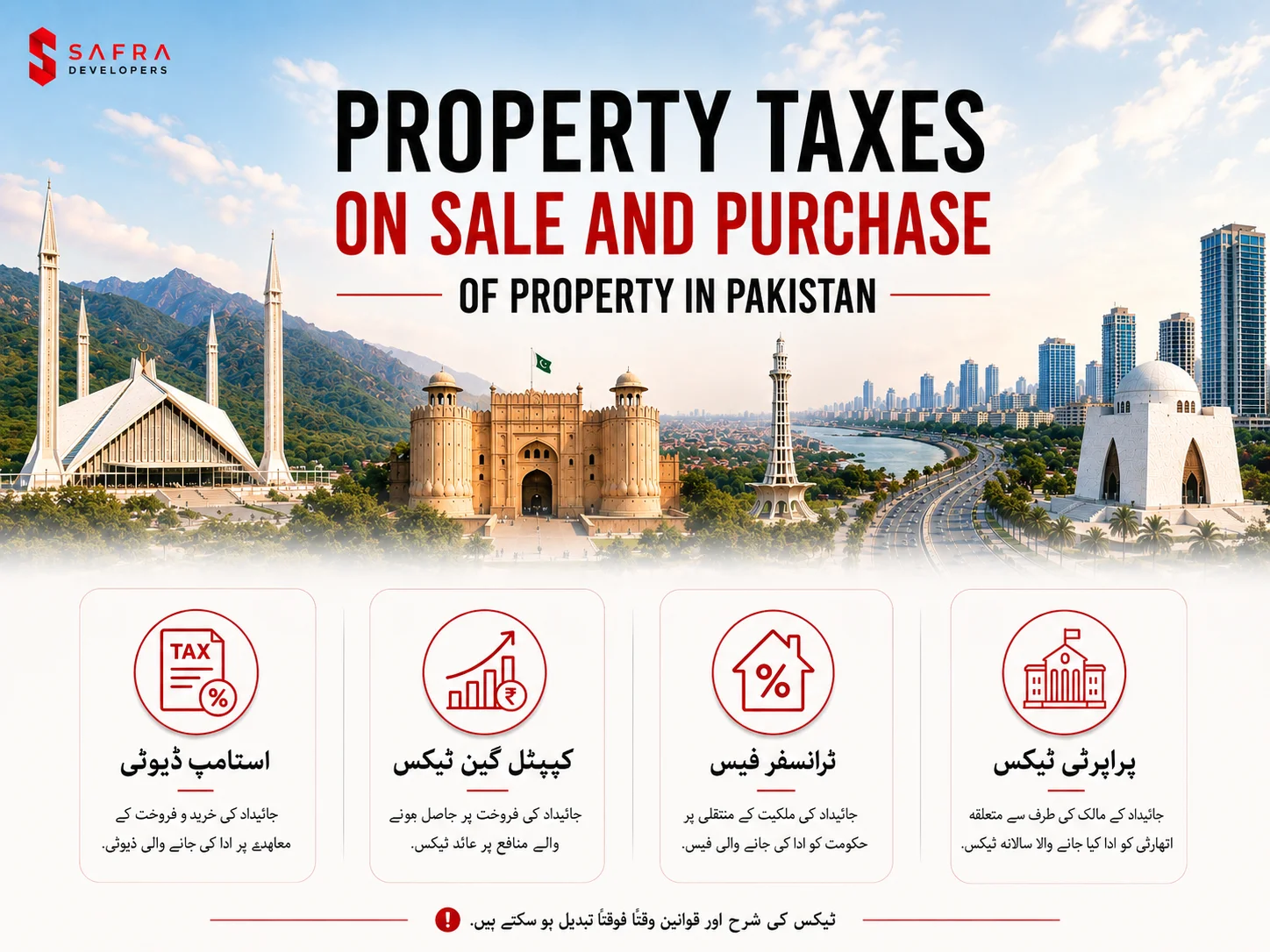
The base of any government lies in its ability to generate significant revenue through tax collection. This revenue is then used for citizen welfare and for providing basic citizen rights. Real estate, which is a promising investment platform, is also subject to certain taxes that are variable depending on filer status, property types, etc. If you are planning to sell or purchase a property, it is important to be aware of the different taxes needed to be paid, as they can affect the total sale or purchase cost of your property.
This article discusses different types of taxes in real estate, conditions related to their variation, and the current tax scenario in light of the budget 2025-2026.
Property Tax Structure
In Pakistan, Taxes on property transactions are collected by government bodies and are divided between provincial and federal governments. The taxes on properties are determined in two ways
- DC Values
- FBR values
These may be fixed values or a percentage of profit or revenue coming from the property.
Federal Board of Revenue (FBR)
The Federal Board of Revenue (FBR) is the main government institution that collects taxes and counters tax fraud throughout Pakistan. The tax collection system is different in the filer vs. non-filer scenario. In the FBR system, taxpayers are classified as follows:
- Filer: The one who submits annual tax returns within the deadline and is a part of ATL.
- Late Filer: The one who submits an annual tax return after the deadline and faces surcharges.
- Non-Filer: The one who does not submit annual tax returns at all.
Types of Taxes on Property Transactions
The main taxes that are to be paid during the sale or purchase of property include:
- Capital Gains Tax (CGT)
- Withholding Tax (WHT)
- Capital Value Tax (CVT)
- Federal Excise Duty (FED)
- Stamp Duty
Capital Gains Tax (CGT)
This is a tax that is paid on the profit made by the sale of a property. This tax is collected by FBR and is paid by the party who sold the property. The CGT tax is higher for non-filers than for filers. The CGT is applicable only within 6 years of purchase which means if the property is sold within 6 years after buying it, the seller has to pay CGT ranging from 15-0% depending on the year sold.
Budget 2025-2026: The CGT will eventually decrease to 0% from 15% in 6 years holding period. According to the budget 2025-2026, CGT will be 15% of the profit for properties bought after Jul 1, 2024, and will not undergo any decline with holding time.
Withholding Tax (WHT)
This is a tax paid during a property transaction and is paid by both the buyer and seller of the property, although tax amounts differ for both. The tax amount also differs with if the taxpayer is a filer or not, as well as for residential and commercial properties.
- WHT on Buyers
| Property Value | WHT for Filers | WHT for Late-filers | WHT for Non-filers |
|---|---|---|---|
| Less than Rs. 50 million | 1.5% | 4.5% | 10.5% |
| Rs. 50-100 million | 2% | 5.5% | 14.5% |
| Above Rs. 100 million | 2.5% | 6.5% | 18.5% |
- WHT on Sellers
| Property Value | WHT for Filers | WHT for Late-filers | WHT for Non-filers |
|---|---|---|---|
| Less than Rs. 50 million | 4.5% | 7.5% | 11.5% |
| Rs. 50-100 million | 5% | 8.5% | 11.5% |
| Above Rs. 100 million | 5.5% | 9.5% | 11.5% |
Budget 2025-2026: According to the recent budget, sellers who have kept the property in their personal use for a period of 15 years will not have to pay WHT. This personal use can be proved through annual tax records. Another noticeable provision is that WHT can now be paid in installments and can also be influenced by the seller's and buyer's income.
Capital Value Tax (CVT)
This is a tax that is paid by the buyer on the net value of the property during the property purchase. This is a provincial tax collected on the basis of DC values.
Budget 2025-2026: According to the budget, 2% of the property DC value is to be paid as CVT.
Federal Excise Duty (FED)
This is a tax that is paid when a property is transferred or booked/allotted. For both residential and commercial properties, 5% of the property value is to be paid as FED.
Budget 2025-2026: In the recent budget, the FED for immovable properties has been nullified and is now applicable only to movable properties.
Stamp Duty
This is a tax that is to be paid on the purchase of a property to the provincial revenue departments. This ranges from 3-5% of the DC values in different provinces.
Budget 2025-2026: According to the latest budget, stamp duty has been set to 1% of the DC value in Punjab and the Federal.
Registration Fee
This is the tax that is paid to record the new owner of the property bought by the buyer. This tax is collected by the provincial revenue department and is different for each province.
- For Punjab: Rs. 500-1000
- For Islamabad: 1% of property value
- For Sindh: 1% of property value
When buying or selling any property in Pakistan, several taxes are applicable, which are collected by the federal and provincial revenue departments. Taxes are paid based on profit margin, property value, transactions, registration, etc. Both buyers and sellers share their respective tax burdens to legalize their property transactions. The recent 2025-2026 budget has reduced WHT and stamp duty while removing FED from the tax system. This has made the property selling and buying processes comparatively easy.
To get detailed information and guidance on the taxes you need to pay when buying or selling your property, you can always contact Safra Developers for risk-free property transfer.