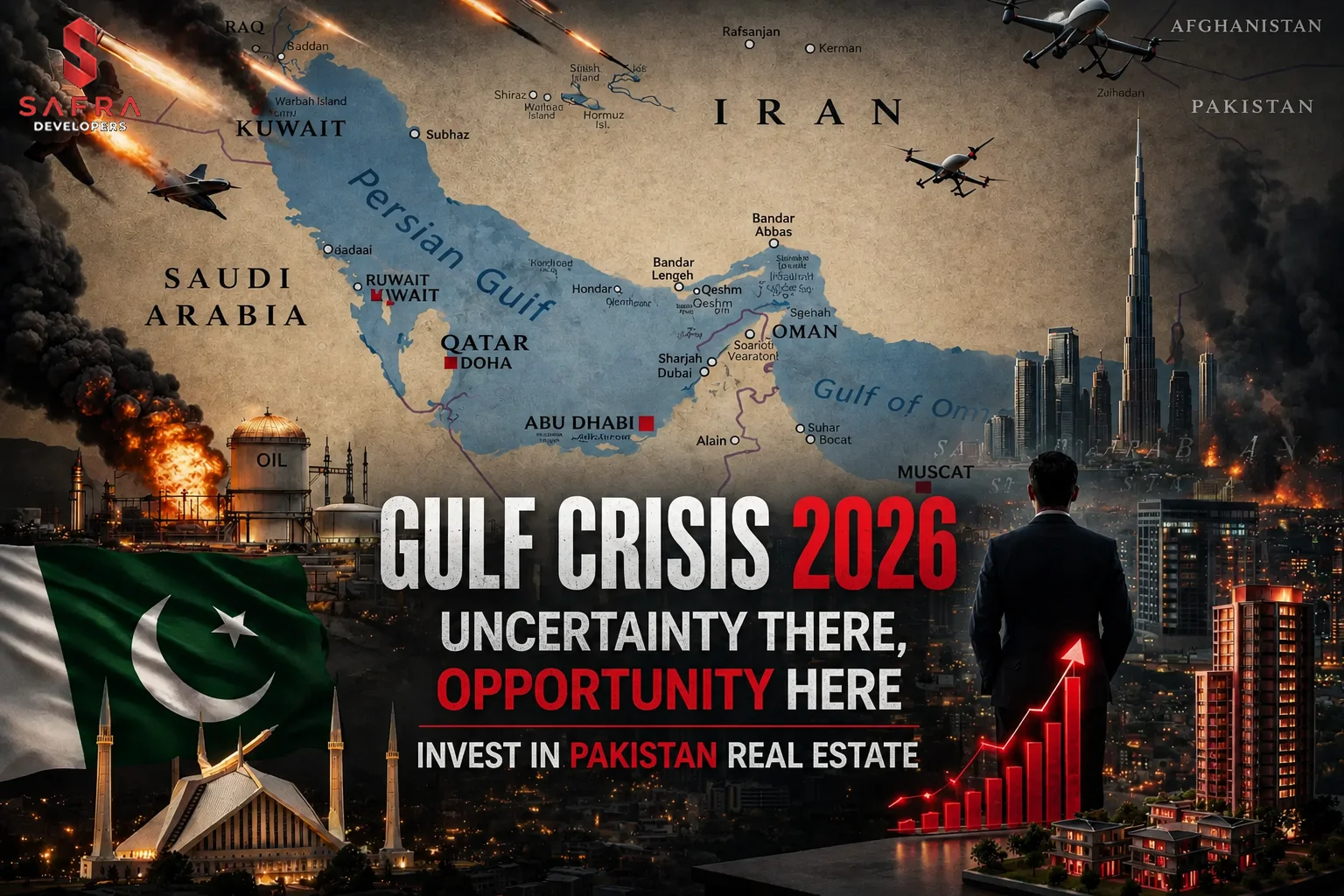
Any global crisis affects the global economy, and so all sectors experience a shift in their trends. The current tensions between the US, Israel, and Iran have caused unrest in the Middle East. Pakistan’s real estate market, like any other country’s market, is very sensitive to global scenarios. The events in Gulf Countries can have a major impact on Pakistan’s real estate. This article discusses the effect of the current international crisis on Pakistan’s real estate market and how this crisis creates an opportunity for the local property market.
Current Market Situation in Gulf
Since late February, Iran, the US, and Israel have been engaged in armed tensions leading to attacks and counterattacks within the Gulf Region. Political instability has always been a main factor influencing economic stability in any region. This political crisis has led to economic uncertainty in the Middle East. Some main economic developments that have resulted from this situation are:
- The traffic from the Strait of Hormuz is blocked, which means that most of the oil supply from Gulf states has dropped considerably. In the broader picture, oil prices have gone up.
- The security in Gulf states has been compromised, causing many foreign citizens in the region to return to their homelands.
- From an investment point of view, the chaos in the Middle East has created uncertainty in the market, leading to many investors withdrawing their investment and moving it to other countries.
How is Pakistan Related to this Crisis?
Any development in Gulf Countries is known to impact Pakistan’s economic state. There are several reasons for this effect.
- Most overseas Pakistanis reside in Middle Eastern states, from which they send their earnings back to their families in Pakistan. This contributes to a major amount coming to Pakistan. Of the 30 billion dollars coming to Pakistan from overseas citizens every year, 54% are from the Gulf States.
- Pakistani investors have a great share in the markets of Gulf countries. Pakistan has remained among the top 5 investing countries in the UAE.
- The Gulf Countries are the main Oil exporters and contribute much to the global oil supply. This means that the situation in the Gulf Countries, or the Gulf Countries themselves, controls oil prices. Pakistan imports most of its oil from Gulf states.
- Inflation in Pakistan mainly depends on oil prices, so any change in oil prices affects inflation rates.
Opportunity for Pakistan’s Real Estate
Increase in Property Prices
The current crisis has caused a spike in oil prices globally, with a trickle-down effect on Pakistan as well. In Pakistan, oil prices mainly govern inflation rates. Real estate is among the top sectors affected by the oil price increase. It is because an increase in oil prices increases raw material production cost, transportation cost, and installation costs as well. This means building a new property, and projects can become expensive. Therefore, the property prices also undergo an increase.
While the property market experiences high property prices, the properties already built and established can enjoy value appreciation since their construction was completed at a time of lower inflation rates, and so have a greater profit margin.
Investment Returning to the Local Market
The dispute in the Gulf region has created an overall unstable and uncertain situation for investors from all over the world. These regions, particularly the UAE, had a massive investment inflow from Pakistan. Pakistani investors directed domestic investment to the international market for security.
Now that the security is crippled in the region, local investors are questioning this direction to the Middle East. There are very high chances that this investment can move back to Pakistan since the local settings provide higher security and stability comparatively. This can, in turn, increase opportunities in the local real estate market.
Need Guidance on Investment?
Connect with Safra Developers for trusted guidance and premium real estate investment opportunities.
✔ Trusted by hundreds of investors across Pakistan
✔ Verified projects & transparent dealings
✔ Expert guidance for secure property investment
Shifts from Currency to Hard Assets
Political turmoil internationally has effects on the global economy and also creates an effect on Pakistan’s economy. When fuel prices skyrocket, it gives birth to a storm of inflation. Speaking from a finance perspective, inflation in Pakistan is often related to currency devaluation.
Such currency devaluation creates panic among investors, and they move towards preserving their capital’s value. In doing so, investors invest in solid assets. In short, investment in property can help preserve money value.
Low Supply Increases Demand for New Projects
From a broader perspective, an increase in property prices can slow down the development of new projects due to high construction costs. From basic economics, we know the supply-demand cycle; the lower the supply, the higher the demand gets.
In the short term, new development can slow down and appear to have a stagnant period, but this would, in turn, generate pressure on the system. With growth in urban requirements, the need for new developments would arise to accommodate the increasing urban population, and so in the long term, it would stimulate greater development.
Establishment of RERA to attract Investment
Currently, the Prime Minister of Pakistan has approved the establishment of the Real Estate Regulatory Authority (RERA) as a step to standardize and regulate the property market. This would create professionalism in real estate agents, control property fraud, introduce documentation, and provide timely conflict-solving in the not-so-formal real estate sector of Pakistan. This step is taken to increase the confidence of investors and as an attempt to seize the investment moving out of the Middle East.
Government Steps to Boost Real Estate
The Government of Pakistan is working to stimulate the property market by providing incentives, tax reductions, and promoting low-budget housing. Furthermore, RERA will be established to monitor the market. This step is expected to cause a stir in the real estate market.
Challenges to Pakistan’s Real Estate
The current conflict opens doors of opportunity for the local property market, and also poses certain challenges, such as
- The high cost of construction can slow down the development of new projects and can also delay projects underway, along with an increase in the overall cost of completion.
- The investors will invest in a more defensive form, where investment from new projects can shift towards built projects and those with good rental income.
- Most Investors in the Middle East are also those working there. The ongoing crisis can threaten their source of income, ultimately reducing the remittances. This can somehow slow down investment in the property market.
The current Gulf Crisis due to war between Iran, Israel and US has led to an uncertain situation in the Middle East. This is causing many investors to withdraw their investments and to move them to more safer inceatment areas. This can act as an opportunity for Pakistan’s real estate as it has inherent properties safeguarding investor interests. Furthermore steps from government can also attract this foreign investment towards local market.