
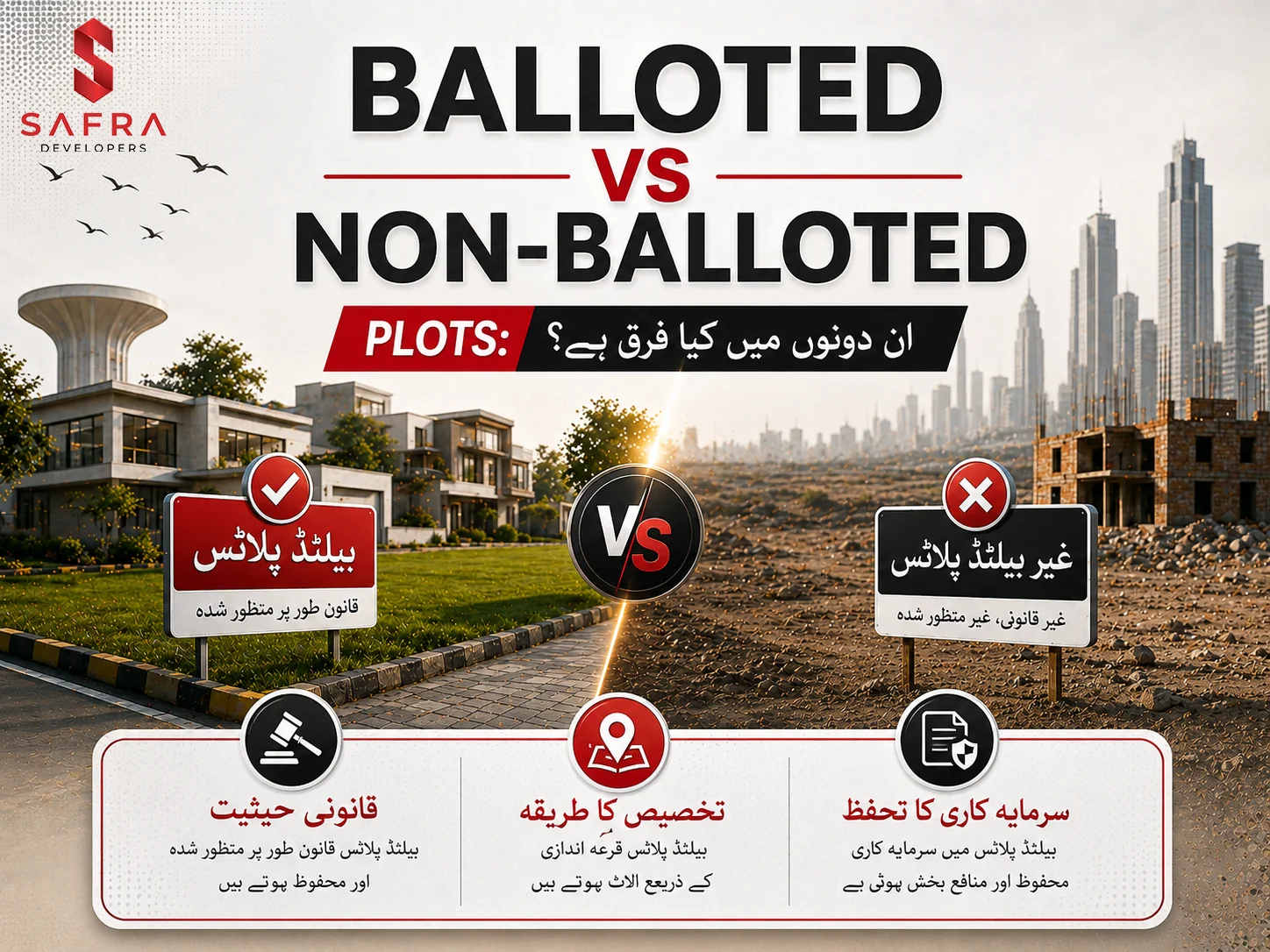
In the real estate sector, you might have heard terms such as balloted plots and non-balloted plots. These are common terms in property markets around the world but to a layman or a new property buyer, they can seem confusing. Any such confusion can lead to losses. To prevent any such loss you need to understand balloted and non-balloted plots.
This article will take you through all the details of balloted and non-balloted plots, their differences, process to obtain each so that you can make a better investment decision.
Difference between Plot File and Plot
To understand balloted and non-balloted plots, you first need to know plots and plot files.
Plot
A plot is simply a piece of land that can be owned and developed. It has a clear existence with a location, boundaries and neighbourhood. It can vary in sizes such as 5 marla, 10 marla, etc., it can be of a particular land use, such as residential, commercial, industrial or agricultural.
Plot File
A plot file is an unofficial promise for a plot in a project that is under development. This gives the plot file holder the right to have a plot, but gives no assurance as to whether he will actually get a plot allocated. It is because a plot is not provided, and there is no practical existence of that piece of land.
| Plot | Plot File | |
|---|---|---|
| Definition | A physical piece of land ready for construction | A reservation/booking for a future plot |
| Nature | Tangible asset with physical existence | Intangible promise without a specific land piece initially |
| Ownership | Full ownership rights over a specific plot | Right to receive a plot in the future |
| Location Certainty | The exact location is known | Location not confirmed until balloting |
| Development Status | Usually, in a developed or near-developed area | Typically, in early or initial development stages |
Balloted Plot
A balloted plot is the plot allocated to a buyer by the developer through a balloting process. In the balloting process, a lucky draw is conducted among the people with a plot file. In this lucky draw, the location of each buyer is determined through a fair and transparent process.
In Pakistan, balloting is mostly conducted by
- Private housing authorities
- Management of a developing company
- Government, in the case of government schemes.
When a new housing scheme is launched, it of course offers some attractive features. This causes a large number of purchasers wanting a plot in the project. When the demand is higher than the plots available, the management conducts a draw so that everyone gets a fair chance to have a plot. This draw is often conducted on media or in front of a neutral 3rd party.
Non-Balloted Plot
A non-balloted plot refers to a plot file with no physical standing and is only in the form of an unofficial document. This plot type is awaiting balloting and has not gone through the balloting process.
Balloting Process
As described above, balloting is a lucky draw of plots in a particular housing society. This is a simple process but it is not as straightforward as you think. It involves some steps, which are listed below:
- Project Announcement
A new housing society is announced with all the details such as location, facilities, master plan, layout plan, payment plan and development timeline. This attracts investors and homebuyers to a certain project.
- Application Submission
The investors and homebuyers access an application form through the developing company’s website in order to book a non-balloted plot. The form is filled and submitted. An application processing fee or booking fee must also be submitted to complete the application process.
- Document Verification
The management of the project sets forth an eligibility criterion. The submitted applications are then verified against the criteria on the basis of the documents submitted and the payment given. Any non-eligible applications are ruled out of the balloting process.
- The Ballot
The draw is conducted in which applicants are assigned a plot number. This ballot can be manual or digitized. The results can be provided live through television or through a list on the website.
- Allocation and Possession
Once the applicants are assigned their plots, they are required to make a larger payment, which leads to providing them with an allocation letter. After development is completed, they are given possession of their plot.
Difference Between Balloted and Non-Balloted Plots
| Balloted Plot | Non-Balloted Plot | |
|---|---|---|
| Definition | A plot that has gone through the balloting process and has been allocated a specific plot number | A plot file that has not yet gone through balloting and has no specific plot assigned |
| Nature | Converted from a file into a specific, identifiable plot | Still a promise or booking for a future plot |
| Plot Number | Assigned after balloting | Not assigned |
| Location | The exact location is known and marked on the society map | Location is unknown until future balloting |
| Ownership | Higher clarity due to allocation | Lower clarity due to uncertainty |
| Risk | Lower risk compared to non-balloted files | Higher risk due to uncertainty and dependency on future balloting |
| Price | Higher price due to confirmed allocation | Lower price as it is still unallocated |
| Market Demand | Higher demand due to certainty | Lower demand but attractive for low-budget investors |
Both balloted and non-balloted plots are used in real estate and may be confusing to many people. Balloted plots usually go through the balloting process (lucky draw), after which the exact plot number and location are allotted, in contrast to the non-balloted plots, which are simple plot files with no practical existence. Where non-balloted plots offer affordable prices, they are often risky with low resale value. Balloted plots, on the other hand, are relatively expensive but are more profitable in the long run.