
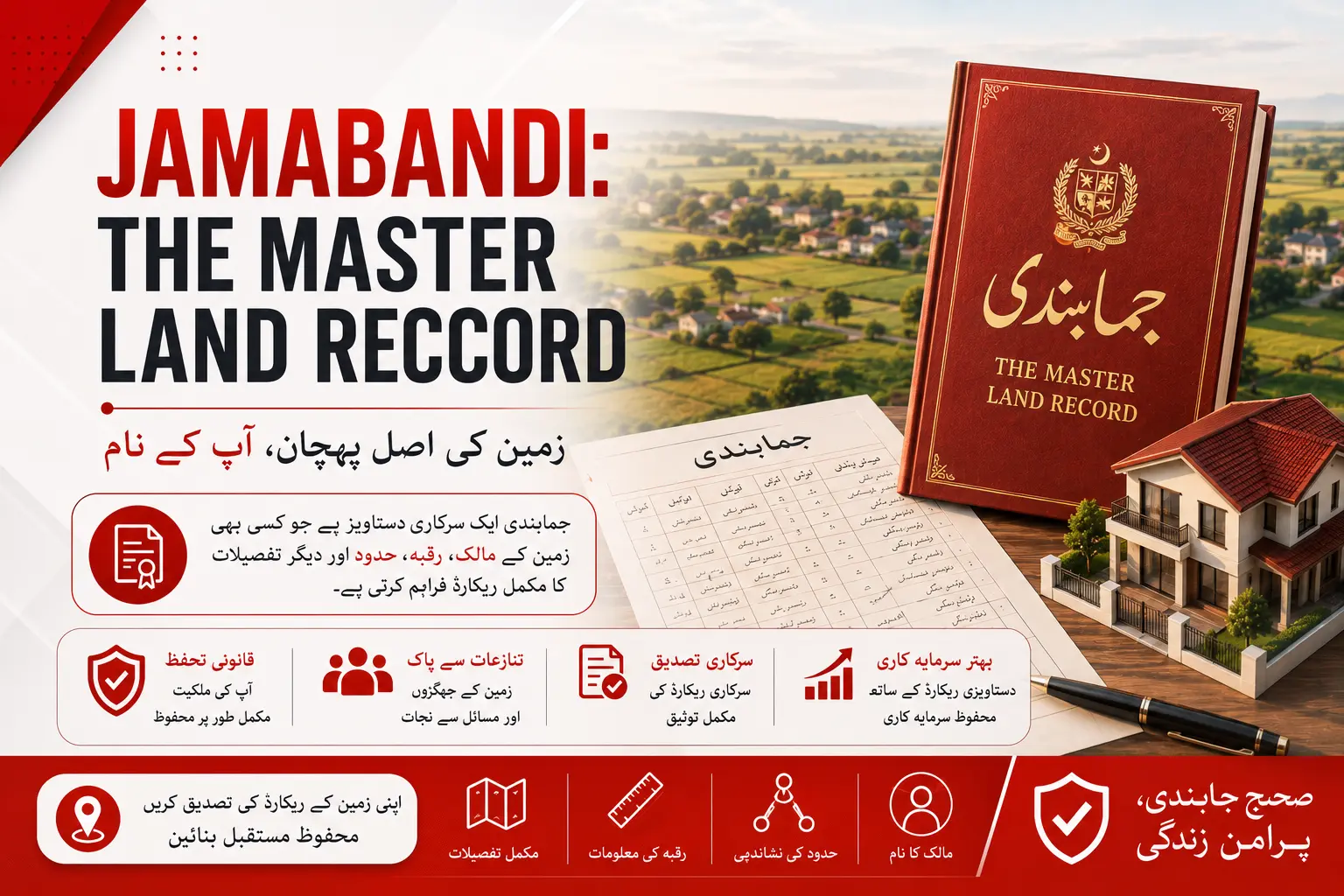
Jamabandi is the official record of a land maintained by the government, holding legal value. This record is maintained by the Land Revenue Departments of each province of Pakistan and is used for administrative management and revenue generation from the property sector. This Record of Rights (RoR) contains essential information about the land and its owner. The revenue departments update it every four years.
It is also called Fard Jamabandi or simply Fard when referring to the printed copy you get from the government.
Jamabandi Maintaining Authority
The responsibility of maintaining a Jamabandi lies with the Land Revenue Department of each province. In the revenue departments, the land revenue officials who are locally called patwaris, maintain the RoR. The government assigns every area with a patwari. A patwari is responsible for recording all land transactions, ownership changes, and updates in his area. Every few years, the Jamabandi is officially updated, and this updating process is called Tadad or the periodic settlement.
Functions of Jamabandi
Initially, the concept of Jamabandi was produced by British settlers ruling the sub-continent mainly for agrarian land to maintain a record of agricultural lands in the area and their owners, from whom the tax was to be collected.
However, this jamabandi is now used to provide multiple functions, which include:
- Proving who legally owns a piece of land
- Resolving property disputes in courts
- Processing inheritance after someone passes away
- Getting bank loans against land
- Completing property sales and purchases
- Government development planning
Components of Jamabandi
Jamabandi is the official land record certificate that the government maintains regarding any land. This document contains information on land and owner details. The specific details which are constitute the Jamabandi are:
- Owner's name: The name of the person or persons who own the land, along with their father's name.
- Khasra number: Every piece of land in Pakistan has a unique number called a Khasra number. It is more similar to a registration number by which the land is identified in the records.
- Size of land: The area of the land, usually measured in marla, kanal, or acres.
- Type of land: Whether the land is agricultural, residential, commercial, or something else.
- How ownership was obtained: It states the process or source through which the owner obtained the land, such as purchase, inheritance, gift, etc.
- Cultivation details: For agricultural land, it also records whether the land is being farmed and who is farming it.
- Encumbrances: If there is any loan, mortgage, or legal case attached to the property, that will also appear in the Jamabandi.
Digitalization in Punjab
In Punjab, the government has converted the conventional jamabandi into a digital system through the creation of the Punjab Land Record Authority (PLRA). This authority has maintained an online portal supported by a digital database. The PLRA provides the following functions:
- Check the Jamabandi of any property online at punjab-zameen.gov.pk
- Get a Fard from an Arazi Record Centre (ARC)
- Apply for ownership changes, also known as mutation online
- Track your application without needing to visit any office
Difference between Jamabandi, Fard, and Mutation
For a new person in the real estate sector, Jamabandi, Fard, and mutation can be confusing terms, as apparently they all seem to be records of land and owners in the government system. But these terms need not be confused, as any confusion can lead to a fatal decision or loss.
The table below explains the difference between these terms.
| Factor | Fard | Jamabandi | Mutation / Inteqal |
| What it is | A printed extract (certificate) of the land record for one specific property | The master land revenue register contains ownership records of all land in an area | The process of updating the Jamabandi after an ownership change |
| Type | Document (Output/Certificate) | Record/Register (Source Database) | Process/Legal Action |
| Purpose | Verify current ownership of a specific property before buying or selling | Maintain a comprehensive state record of all land ownership for revenue and legal purposes | Transfer the ownership entry in Jamabandi from the old owner to the new owner |
| Issued / Maintained By | PLRA / Arazi Record Centre (Punjab), SLRA (Sindh), or Patwari Office | Revenue Department, through Patwari, is maintained digitally by PLRA in Punjab | Patwari, approved by Tehsildar or PLRA Arazi Record Centre |
| Who Uses It | Buyers, sellers, banks, lawyers, and anyone verifying ownership | Revenue officials, courts, land administrators, banks | Buyers, heirs, gift recipients, and anyone receiving a property transfer |
| When to Use It | Before paying token money or signing a property agreement | During court cases, revenue assessment, and administrative decisions | Immediately after a sale, inheritance, gift, exchange, or any ownership transfer |
| Information Contained | Owner name, Khasra number, land size, land type, encumbrances, mutation history | Ownership records, Khasra details, tenancy information, cultivation status for all plots | Nature of transfer, previous owner, new owner, transfer date, supporting documents |
| Available Online? | Yes, in Punjab through PLRA; partially in Sindh | Viewable through PLRA in Punjab, but not downloadable as a complete register | Online application available through PLRA and Arazi Record Centres |
| Relationship to Others | Extracted from the Jamabandi | Updated through Mutations; serves as the source for Fard issuance | Updates the Jamabandi; a new Fard reflects the change afterward |
Jamabandi is the record of the land in an area maintained by a government body, which in Pakistan is the Land Revenue Department of provinces. It contains detailed info on every land in the area, such as its location, size, and owners, etc. These records are mostly maintained through the conventional methods in many areas through patwaris, except in Punjab, after the creation of the Punjab Land Revenue Authority (PLRA).