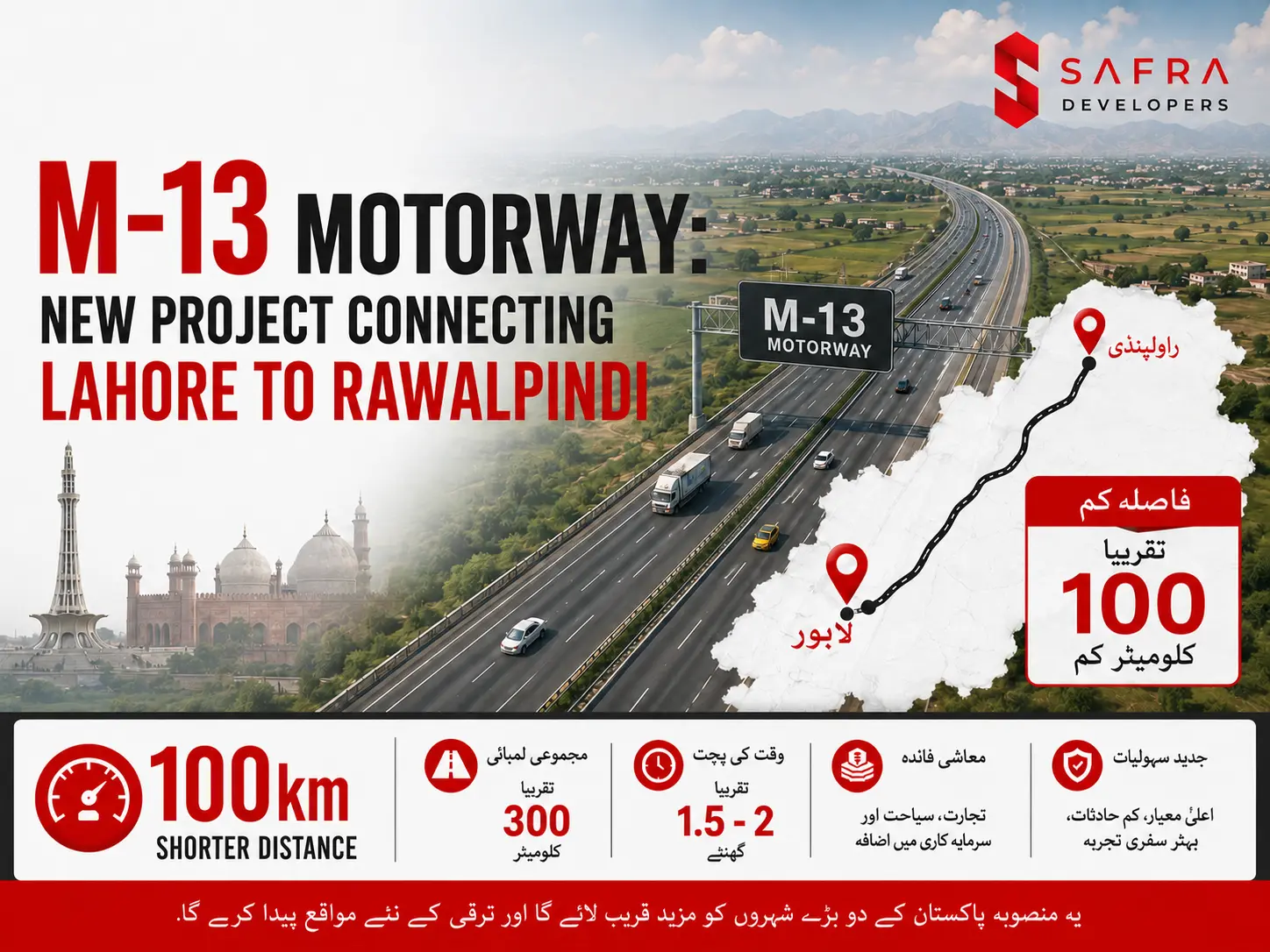
The government of Punjab has decided to add a new Rs 205 billion motorway, the M-13 Motorway, to the national motorway network. This new motorway, also known as the Kharian–Rawalpindi Motorway, is a new road infrastructure under development to reduce travel time between Lahore and Rawalpindi, the development of which is awarded to FWO.
The M-13 is a 117.2 km, six-lane motorway connecting Kharian to Rawalpindi and is officially known as the Kharian–Rawalpindi Motorway. This motorway has been under construction since September 2022 and is designed for a top speed of 120 km/h.
M-13 Motorway Characteristics
The motorway is being designed to provide modern road infrastructure with safety for pedestrians and ease of travel for vehicles. The specific characteristics of the motorway are:
- The motorway includes 8 interchanges along the route
- Will have 2 dedicated service areas for travelers
- A total of 26 bridges, including a major crossing over the River Jhelum
- Two twin-tube tunnels will be built to safely cross the Salt Range between Dina and Sohawa. One tunnel is 1.3 km and the other will be 0.6 km long.
- A full six-lane design built to handle both passenger and heavy freight traffic
Connectivity of M-13 Motorway
The M-13 motorway will be connected to many other important motorways and road networks in the region. This interconnectivity will enhance the travel experience for people. The main roads interconnecting with M-13 are:
- M-13 connects directly with the M-11 (Lahore–Sialkot Motorway) at Kharian, forming a continuous corridor
- It links to the M-12 (Sialkot–Kharian Motorway)
- It will also link up with T-Chowk near Rawat, Rawalpindi
- Plans are also underway to widen the existing M-11 from four lanes to six lanes
- M-13 will also link to the M-2 Motorway via the Rawalpindi Ring Road
- Once M-11, M-12, and M-13 are all fully operational, traffic planners estimate that 50–60% of commuters and freight currently using the M-2 could shift to this newer route
Importance of M-13 Motorway
M-13 is a desired project since it offers the following great advantages to the area:
- Shortens the Lahore–Rawalpindi travel distance by nearly 100 km compared to the existing M-2 route
- Cuts travel time between Lahore and Islamabad by roughly one hour
- Offers a much-needed alternative to the heavily congested M-2 Motorway
- Pulls traffic away from the parallel N-5 (GT Road) highway, which has long suffered from overcrowding and safety issues
- Bypasses the accident-prone Salt Range gradients near Kallar Kahar through purpose-built tunnels
Developer of M-13 Motorway
The government has skipped the formal bidding process for the construction of the project, and the development of the motorway has officially been awarded to the Frontier Works Organisation (FWO) through a negotiated procurement process. The FWO was selected because it's already working on the Lahore–Sialkot and Sialkot–Kharian motorway sections.
Budget
Originally, the government approved Rs. 96 billion for the project in January, 2022. But since then, the project cost has continued to increase to about Rs. 205 billion today, which is approx. double the initial budget. This increase in costs is linked to the decision to expand the motorway from four lanes to six lanes, under the directives from the Special Investment Facilitation Council (SIFC). Overall, the project will be executed under a Build-Operate-Transfer (BOT) model.
M-13 is a very ambitious road infrastructure project aimed at providing greater travel speeds for city-to-city travel and is expected to reduce travel time between Rawalpindi and Lahore by one hour. The project, after being awarded to FWO for construction, is expected to undergo rapid development and completion in the near future.