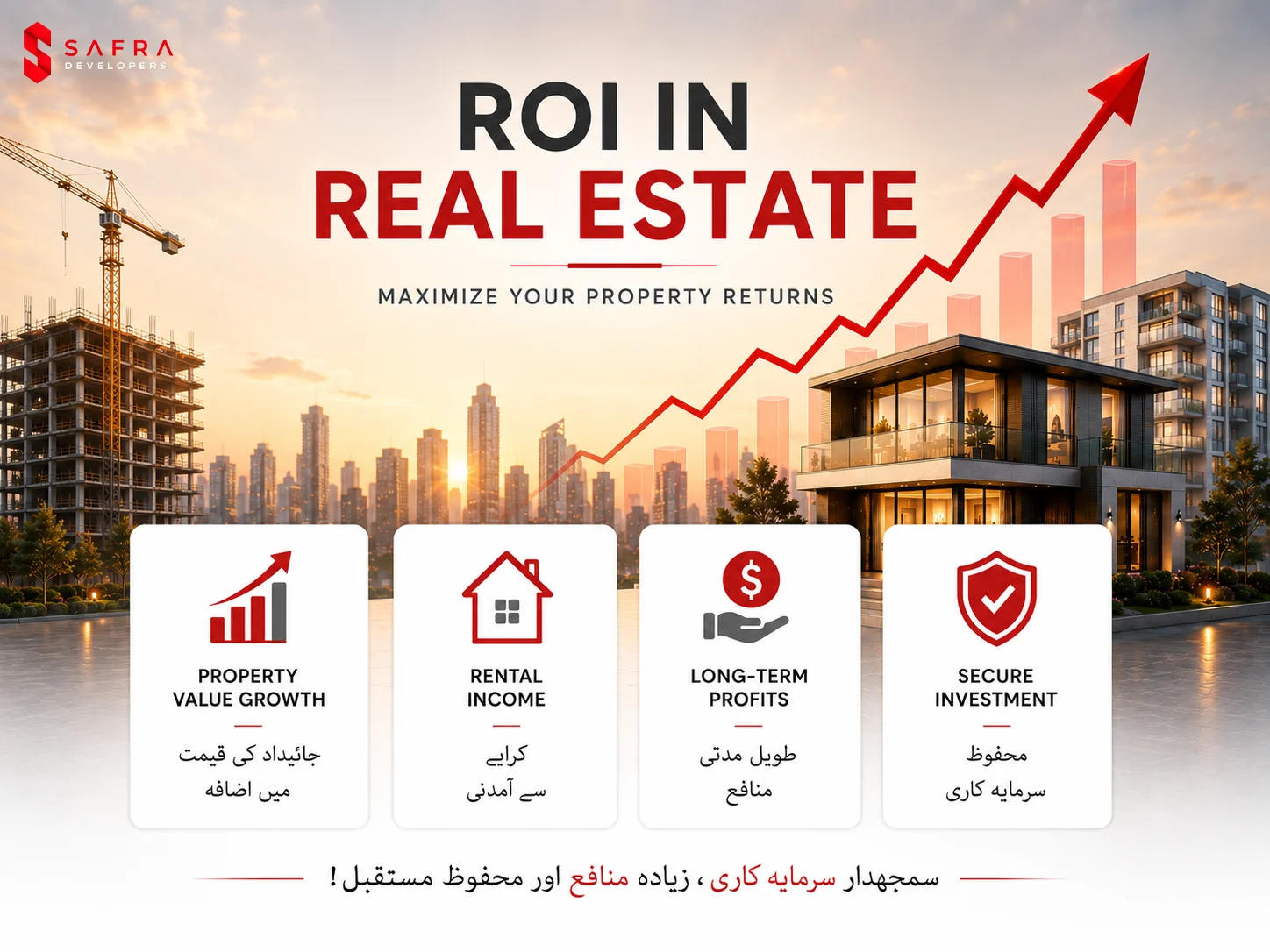
What is ROI
Return on Investment (ROI) is a measure of profit coming from any investment. This metric compares the cost of investment with the profit generated and is expressed in terms of a percentage. In simpler terms, it allows investors to determine the profitability of any investment.
Uses of ROI
An ROI is used in real estate for multiple purposes. The following are some important areas where ROI is utilized:
- It allows the investor to determine the degree of profit resulting from an investment.
- It assists in the comparison of different investment options to identify the best possible option.
- It also helps in analyzing risks and profits related to an investment through a simple cost-benefit analysis.
- It also facilitates the investor in planning long-term investments.
How To Calculate ROI?
Return on Investment (ROI) can easily be calculated by a very simple formula, which involves dividing total profit by total investment cost and expressing the number obtained as a percentage. The formula is given below as:
ROI = (Net Profit / Cost of Investment) × 100
In most cases, the Net Profit is often obtained by subtracting the costs of the investment from the profit. The formula ten can be expressed as:
ROI = ((Net Profit − Cost of Investment) / Cost of Investment) × 100
Suppose you purchase a residential plot in Islamabad for PKR 5,000,000. Three years later, you sell it for PKR 8,000,000.
Net Profit = 8,000,000 − 5,000,000 = 3,000,000
ROI = (3,000,000 / 5,000,000) × 100 = 60%
Your ROI is 60% over three years. Whether that is a good return depends on context — what other investments were available, what inflation was during those years, and what risks you took to earn that return.
What is a Good ROI?
ROI for an investment can range on a broad spectrum, with investors aiming to get as high an ROI as possible. So, in what range does a good ROI lie? Normally, the ROI ranges from low to high on the following scale:
| ROI Status | ROI Percentage |
|---|---|
| Low ROI | Less than 5% |
| Average ROI | 5-8% |
| Good ROI | 8-12% |
| High ROI | More than 12% |
Types of ROI in Real Estate
ROI can be of different types based on different calculation methods. Each method serves a particular interest most suited to the respective investor.
Some common ROI types include:
| ROI Type | Definition | Formula / Basis | Main Purpose | Example |
|---|---|---|---|---|
| Rental ROI (Rental Yield) | Return earned from rental income generated by a property | Annual Rental Income ÷ Property Cost × 100 | Measures rental profitability | Property worth PKR 10M, earning PKR 600K yearly rent = 6% ROI |
| Capital Gain ROI | Profit earned from the increase in property value over time | (Selling Price – Purchase Price) ÷ Purchase Price × 100 | Measures appreciation in property value | Bought for PKR 8M, sold for PKR 10M = 25% ROI |
| Gross ROI | Return calculated before deducting expenses | Total Income ÷ Total Investment × 100 | Quick profitability estimate | Rent income without deducting taxes or maintenance |
| Net ROI | Return after deducting all property-related expenses | (Income – Expenses) ÷ Total Investment × 100 | Shows actual profit | Includes maintenance, taxes, and management costs |
| Cash-on-Cash ROI | Return on the actual cash invested, usually for financed properties | Annual Cash Flow ÷ Cash Invested × 100 | Evaluates leveraged investments | Down payment PKR 2M generating PKR 240K annual cash flow = 12% |
| Flipping ROI | Profit from buying, renovating, and reselling property | (Sale Profit – Renovation Costs) ÷ Total Investment × 100 | Measures short-term investment success | Buy–renovate–sell projects |
| Development ROI | Return earned from real estate development projects | Project Profit ÷ Development Cost × 100 | Assesses construction or development viability | Housing scheme or commercial plaza development |
| Total ROI | Combined return from rental income and capital appreciation | (Total Profit ÷ Total Investment) × 100 | Gives complete investment performance | Rent income + property value increase combined |
Factors Affecting ROI
ROI is not a one-dimensional metric, their are several factors that influence it and can cause a fluctuation in ROI. The most basic factors that investors should consider before any investment to affect the overall ROI are discussed below:
- Location: The location of the property matters a lot. Highly developed urban areas often generate greater ROI due to more land appreciation than property in rural areas. Similarly, within a city, areas closer to commercial centers have a higher ROI than suburbs.
- Property Type: ROI mainly depends on appreciation, the extent of costs on the property, and demand.
- Residential plots appreciate more but have almost no tenant demand.
- Commercial property has a higher rental yield but experiences more costs with longer tenant-less periods.
- Apartments and other residential properties have low tenant turnover but undergo slow appreciation.
- Market Trends: ROI is very sensitive to the ups and downs of the real estate market. Factors such as economic situation, consumer demand, and inflation strongly influence ROIs. A slow market leads to slow appreciation, reducing ROIs.
- Property Maintenance: The costs of the property are a direct factor affecting the ROI. Costs such as capital costs, maintenance, repairs, and government taxes all determine the net profit, hence the ROI.
- Holding Period: In Pakistan, the holding period of the property is related to the Capital Gain Tax. CGT is higher on short holding periods and reduces with an increase in the holding period. The higher the CGT it becomes a major cost on the property and can reduce the ROI.
Tips to Improve ROI
Some tips that you can follow to boost ROI on your investment are:
- Become a Tax Filer to reduce tax costs
- Carry out development on plots or renovate existing property to add value and increase ROI
- Try to purchase property below market rates
- Stay updated with the holding period vs. tax obligations set by the government
- Before making any agreement related to a property transaction, calculate all costs
- Optimize rental income for higher ROI
Return on Investment is a basic metric that investors use to determine whether the investment is profitable and, if so, to what extent. Simple calculation is expressed in percentage but is affected by many factors such as location, property type, etc. Although ROI is a simple term but can be of different types depending on the investor's preference. In short, this measure is a quite accurate means to determine the viability of property investment in real estate.