
Listen to Brief Comparison between Between Filer & Non Filer
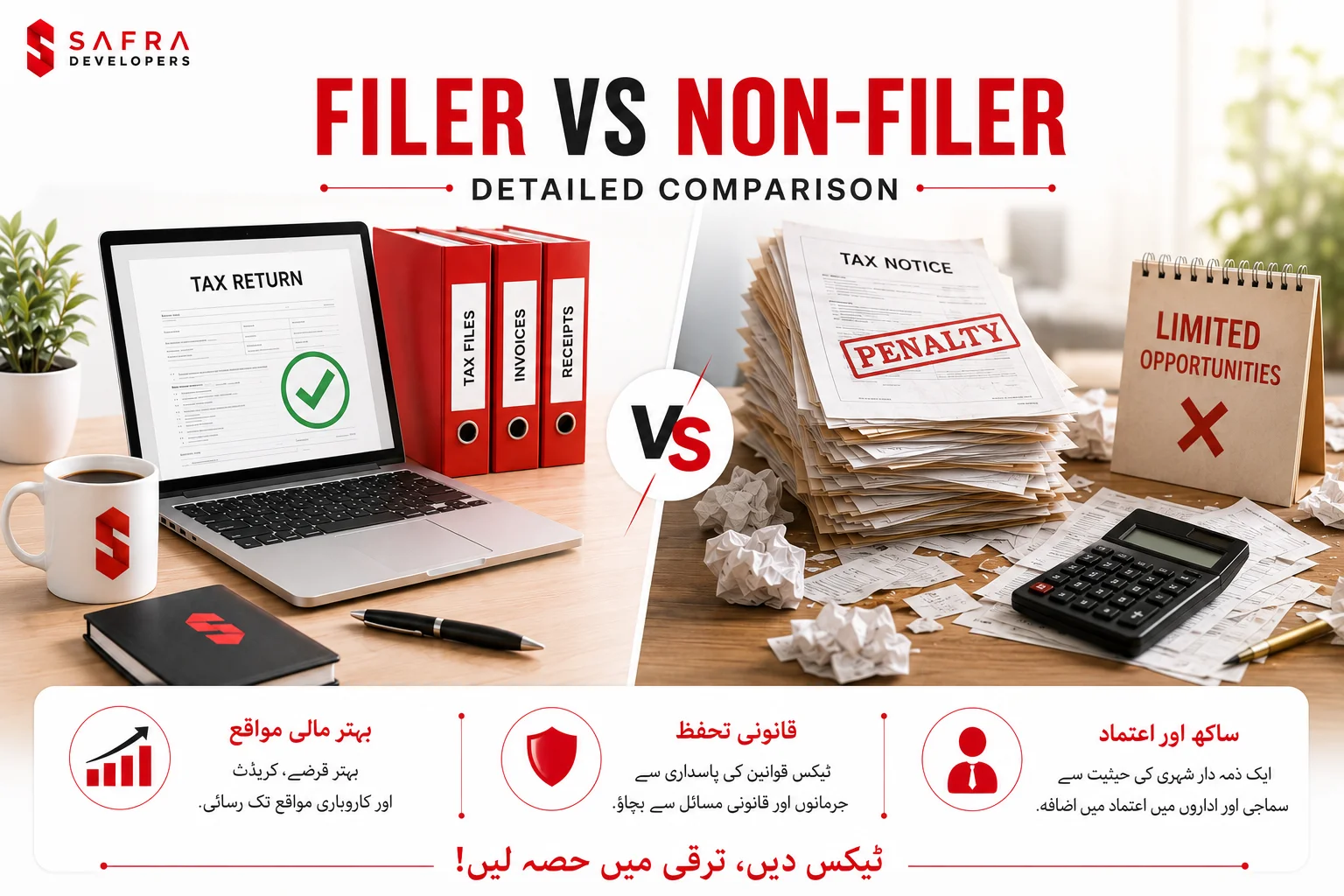
In Pakistan, nearly everything you buy or even sell is taxed. This is the main revenue source for every government, and a responsible citizen never hesitates in paying taxes. But how much tax you should pay on a transaction depends on whether you have filed your annual tax returns on time or not. Based on this, every taxpayer is classified as a filer or non-filer.
Every Pakistani should be aware of what a filer is and what benefits are associated with this title. For this reason, this article will provide detailed information on filer vs. non-filer status and related system characteristics.
Taxpayer Categories: Filer, Late-Filer, and Non-Filer
In Pakistan, the finance system often recognizes two distinct categories based on whether they have paid annual tax or not. However, the Finance Act 2022 now involves three categories, which are:
- Filer: A filer refers to any person or business that submits their annual tax returns within the deadline provided by FBR. A filer has his name listed on the Active Taxpayer List (ATL).
- Late-Filer: A late filer, on the other hand, is such a person or business that still submits their annual tax returns, but after the deadline. They also get enlisted in ATL but have to pay a surcharge fee, which for individuals is 1000 Rs and for companies is 10,000 Rs.
- Non-Filer: A non-filer is simply the person or business that does not submit their annual tax returns. They are not on the ATL.
What is the Active Tax Payer List (ATL)
An Active Taxpayer List (ATL) is the official list that the FBR maintains enlisting the names of individuals and businesses who have filed their tax returns for the particular year, giving them the filer status. The ATL is updated every week by the FBR.
Filer Vs. Non-Filer in Different Economic Sectors
Filers by abiding by the requirements of FBR enjoy many benefits in different transactions when compared with non-filers. Below are discussed the many advantages filers have over non-filers in various sectors.
Property Market
Property transactions are carried out with the inclusion of many taxes, which are variable for both filers and non-filers.
| Tax Type | Filer | Non-Filer | Who Pays? | Notes |
|---|---|---|---|---|
| Capital Gains Tax (CGT) | 15% on profit | Up to 45% | Seller | Budget 2026–27 did not reduce CGT; rate structure remains unchanged. |
| WHT on Purchase (Section 236K) | 1.5% flat rate (all property values) | Higher rates apply | Buyer | Flat rate replaces the previous tiered 1.5% / 2.0% / 2.5% structure, providing relief to buyers. |
| WHT on Sale (Section 236C) | 2.75% flat rate (all property values) | Higher rates apply | Seller | Flat rate replaces the previous tiered 4.5% / 5.0% / 5.5% structure, significantly reducing the tax burden. |
| Section 7E (Deemed Income Tax) | Abolished | Abolished | Property Owner | Removed entirely under Budget 2026–27, eliminating the deemed rental income tax. |
Banking Transactions
Filers pay no tax on cash withdrawals from banks, while non-filers pay 0.6% - 1% on cash withdrawals of more than 50,000 Rs. Also, a filer only has to pay 15% tax on bank profits or interest, while for a non-filer, this percentage is 20-35%. This means that a non-filer who earns a bank profit still takes home less than a filer who earns the same amount.
Vehicle Registration
The registration tax also varies between filers and non-filers. A filer has to pay lower registration charges than a non-filer, which simply varies with the engine CC. For a filer, this registration tax varies from 7,500 to 150,000 Rs, while non-filers have a tax in the range of 15,000 - 600,000.
Investment Incomes
The difference in Withholding Tax (WTH) on dividend and investment income for filers and non-filers is very noticeable. A non-filer has to pay a WTH double the amount which a filer has to pay. This WTH is deducted from the profit by brokerage houses and asset management companies.
Restrictions For Non-Filers
Non-filers, in addition to higher tax rates, also face problems in many day-to-day life requirements.
- Non-filers cannot purchase property above a certain threshold set by FBR each year. This keeps non-filers out of significant portions of Pakistan's real estate market, reducing investment options for them.
- Non-filers face restrictions on banking activities, like opening bank accounts or applying for loans. Banks carry out detailed processing on non-filers, which can slow or block access to financing, credit cards, and other formal financial services.
- Business owners who are non-filers can be disqualified from government contracts, tenders, and supplier relationships with large corporations that require tax compliance certification.
Becoming a Filer
Looking at the vast advantages the economic system has towards a filer, most citizens would like to hold the status. But a simple question runs through their minds: How to become a tax filer in Pakistan?. FBR, through its online IRIS portal, has eased out the process where one only needs to log in to the portal through their NTN and fill a tax return form, which is then submitted online along with required payments, resulting in a receipt generation and enlistment in ATL.
Since the Finance Act 2022, the economic system identifies three categories: filer, late-filer, and non-filer based on annual tax returns filed or not, or if yes, within the deadline or not. Filers enjoy lower taxes as compared to non-filers in various economic sectors such as property, vehicles, banking, investment, etc. While non-filers have to pay higher taxes, they still face problems in many financial activities. This makes becoming a filer a favourable step to avail all such benefits, which can be done through the online IRIS portal of FBR