
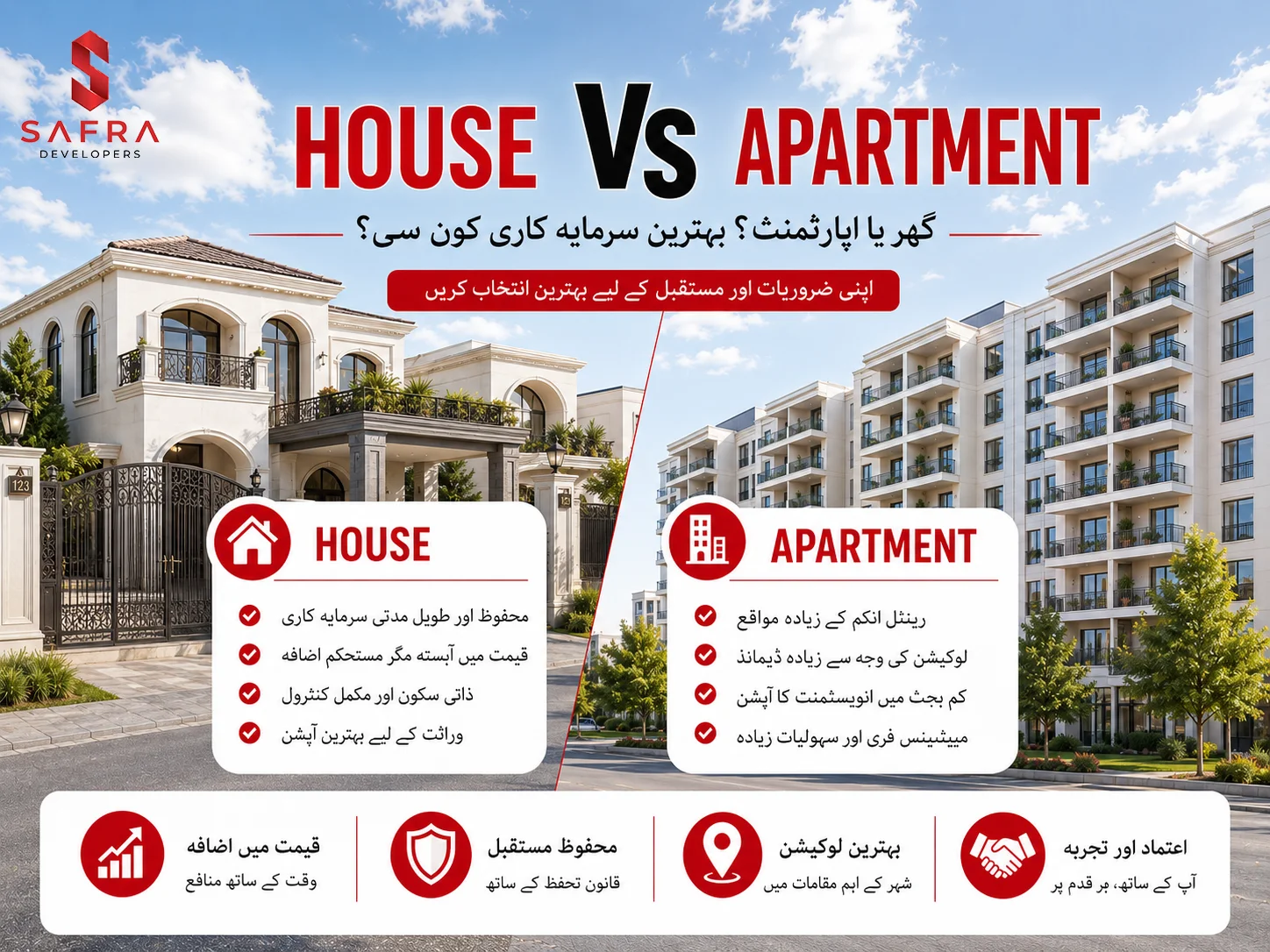
In the property market, the value of a property is often associated with personal preference, costs, location and inherent value. Whether looking for a space to live or an opportunity for investment, one requires detailed information on a house vs. apartment for a more informed decision meeting needs of homebuyer or investor.
This blog discusses the difference between these two residential properties, their characteristics and which one is best for purchase or investment.
House
A house is a freestanding residential body developed on a piece of land offering ownership of both the land and the developed house.
This may be a house in a neighbourhood, a town house or a house in a gated community.
Some main features associated with life in house are as follows:
- Privacy: House offers greater privacy with separate rooms, garage, lawn etc and less shared space.
- More Space: A house offers greater space for families and their uses such as lawn, garage, drawing dining etc for families with many members.
- Personalization and Customization: For a house, an owner can undergo changes, upgradation or expansion according to need and choice.
- Land Ownership: The land of the house can be directly owned and so can result in profit as a result of market fluctuations.
- Higher Maintenance Costs: A house is not a shared unit, the maintenance cost is higher.
- Higher Buying and Renting cost: When buying or renting a house a higher cost applies due to land value, single unit with associated facilities for different uses. A house is associated with higher upfront, deposit and mortgage costs.
- Security: Houses require extra measures to ensure security such as boundary walls, wiring, CCTV installation and hiring a guard.
- Distance from city center: Most residential properties are located in sub-urban areas away from city and commercial centers. Such location in low-density areas poses unavailability to public transport and results in more commute cost and time.
Apartment
An apartment is a single residential unit within a larger residential building where most facilities such as parking areas, open spaces etc are shared by other apartment inhabitants.
These may be a part of condominiums, or small residential buildings with 5 or less than 5 units.
Some main features associated with life in apartment are as follows:
- Lower Purchase or rental costs: Apartments are often a more affordable option for people and families with limited budget.
- Amenities: Apartment buildings offer multiple facilities such as gyms, community halls, commercial activities such as shopping areas, restaurants etc for quick and high quality living experience.
- Low maintenance cost: Apartment inhabitants face less maintenance costs as the maintenance is conducted by building administration while a fraction of the total cost is paid by the apartment inhabitants.
- Low Travel Time: Apartment buildings are often located in urban areas offering high-density living which reduces time and cost for commuting to different city areas.
- Limited Space: Apartments are limited in space and area and so are suitable for individual living or for small families. Large families can feel congested in apartments.
- Less privacy: Due to shared walls and shared amenities, inhabitants can feel interruptions in their privacy.
- Continuous maintenance charges: Although apartment residents may have to pay a fraction of maintenance costs they have to pay fixed monthly charges irrespective of existing maintenance expenses.
- No customization: Since an apartment is a joint property with interference of building administration, residents are not able to carry out customizations independently without approval from building owners.
House Vs. Apartment : Which One is Better
Both houses and apartments offer different features which make them stand out from each other. When making a decision on which one is more suitable. Different factors are considered which determine the overall tradeoff situation.
Some of these factors are discussed as below:
Lifestyle: A different type of lifestyle is associated with each type of residential property.
Houses offer more secluded and private lifestyles where space can be adjusted according to personal preferences and are mostly away from commercial centers providing the peace and calm of residential neighbourhoods.
Apartments on the other hand provide a more community engaging living experience with close proximity to transport and other commercial developments allowing a better interaction with neighbouring families and individuals.
Budget: Life with both houses and apartments lie within different price ranges.
Houses are associated with greater overall purchase and renting costs due to high market value, taxes and demand. Additionally, maintenance costs are higher due to comparatively larger space and infrastructure with no division.
While apartments offer a more budget friendly option with moderate purchase and renting costs and lower maintenance costs due to sharing among building residents.
Security: For houses, security is average and can be compromised if additional measures such as boundary walls, wirings etc are not adopted. Apartments, in contrast, provide greater security due to installed features such as staff, CCTV etc.
Investment: Investment goals can also determine the type of residential property to opt for. Different investment strategies are used by investors on the basis of which the decision of residential property type can be made. Some common strategies include:
- A common method involves purchasing a residential property and renting it out while waiting for the market value of the property to increase. With passage of time as the value increases, it can be sold at a profit. This provides capital through both resale and renting during the hold period.
- Another method is to simply purchase a residential property in a demanding and high yield area and rent it out. With rent being higher than overall maintenance costs, results in a continuous source of income.
- Investors sometimes invest by purchasing an old property with outdated infrastructure where they renovate the property to boost up its market value. With value added, the property can then be sold at a profit, all while keeping the renovation costs below the expected profit.
- Rentvesting is another popular investment strategy where owners themselves live on rent in an affordable area while renting out their residential property in a high demand area. The gap between the rent they pay and the rent they receive acts as a continuous income source.
Comparison between House and Apartment
| Factor | House | Apartment |
|---|---|---|
| Definition | A freestanding residential unit built on owned land | A single unit within a shared residential building |
| Ownership | Ownership includes both building and land | Ownership is limited to the unit; shared ownership of common areas |
| Privacy | High privacy with no shared walls and separate spaces | Less privacy due to shared walls and common facilities |
| Space | Larger space including lawn, garage, and multiple rooms | Limited space, suitable for individuals or small families |
| Customization | Full freedom to modify, expand, or upgrade | Limited or no customization without approval |
| Cost (Purchase/Rent) | Higher due to land value and independent structure | More affordable and budget-friendly |
| Maintenance Cost | High, borne entirely by the owner | Lower, shared among residents through maintenance charges |
| Maintenance Responsibility | Fully managed by the homeowner | Managed by building administration |
| Security | Requires personal arrangements (CCTV, guards, walls) | Better security with shared systems and staff |
| Location | Usually in suburban or low-density areas | Mostly in urban, high-density areas |
| Commute/Accessibility | Longer travel time and higher commuting cost | Shorter travel time due to proximity to city centers |
| Amenities | Limited; self-developed facilities | Access to shared amenities (gyms, halls, shops, etc.) |
| Lifestyle | Private, peaceful, and independent living | Community-based, social, and convenient living |
| Family Suitability | Ideal for large families | Best for individuals or small families |
| Ongoing Charges | No fixed monthly charges but variable maintenance expenses | Fixed monthly maintenance charges regardless of usage |
| Investment Potential | Strong due to land appreciation and resale value | Good for rental income and affordability-driven demand |
| Flexibility | High flexibility in usage and expansion | Limited flexibility due to building regulations |
Concluding the above discussion it can be said that if a residential property is being purchased for living, a house is better if the preference is a more private, personal and calm life while an apartment is better if the preference is an affordable and a secure life close to all main amenities. From an investment point of view, houses are better due to land appreciations and instant resale ability while apartments are better as they are more affordable resulting in greater demand among tenants.