
In the real estate market, property prices are forever changing and adjusting according to market trends. Determining the real value of any property allows profit based transactions, legal and taxation compliance and transparency in the property market. One important step in determining the value is to identify the DC valuation of your property. This article guides you through the basics of property DC valuation, its importance and how you can determine it for your property.
What is Property DC Valuation
“DC Valuation of a property is a valuation metric used by the government of Pakistan and is the official price of that property set by the District Commissioner of the area”
The intent is to assign a standardised value to properties to manage tax collection, market regulation and record maintenance.
Functions of DC Property Valuation
Property DC valuation is an attractive regulatory and managerial tool due to its associated uses. Some of its functions are
- Taxation: DC valuation creates a standard for each property type according to which taxation criteria can be developed. This avoids any chances of under or over taxation.
- Controlling tax frauds: DC valuation is used to determine the minimum value a property holds to collect relevant tax. This reduces the chance of declaring property as under value to commit tax thefts.
- Investment decision assistance: DC valuation acts as a threshold in the real estate market through which market value can be assessed to determine profit or loss in case of any sale or purchase decisions.
- Legality: This valuation ensures compliance to government regulations since it requires proper documentation related to the property and so it can reduce chances of real estate scams due to record maintenance in government offices.
- Market regulation: DC valuation keeps the property prices within the acceptable radius thereby, avoiding any distorted valuation and overpricing.
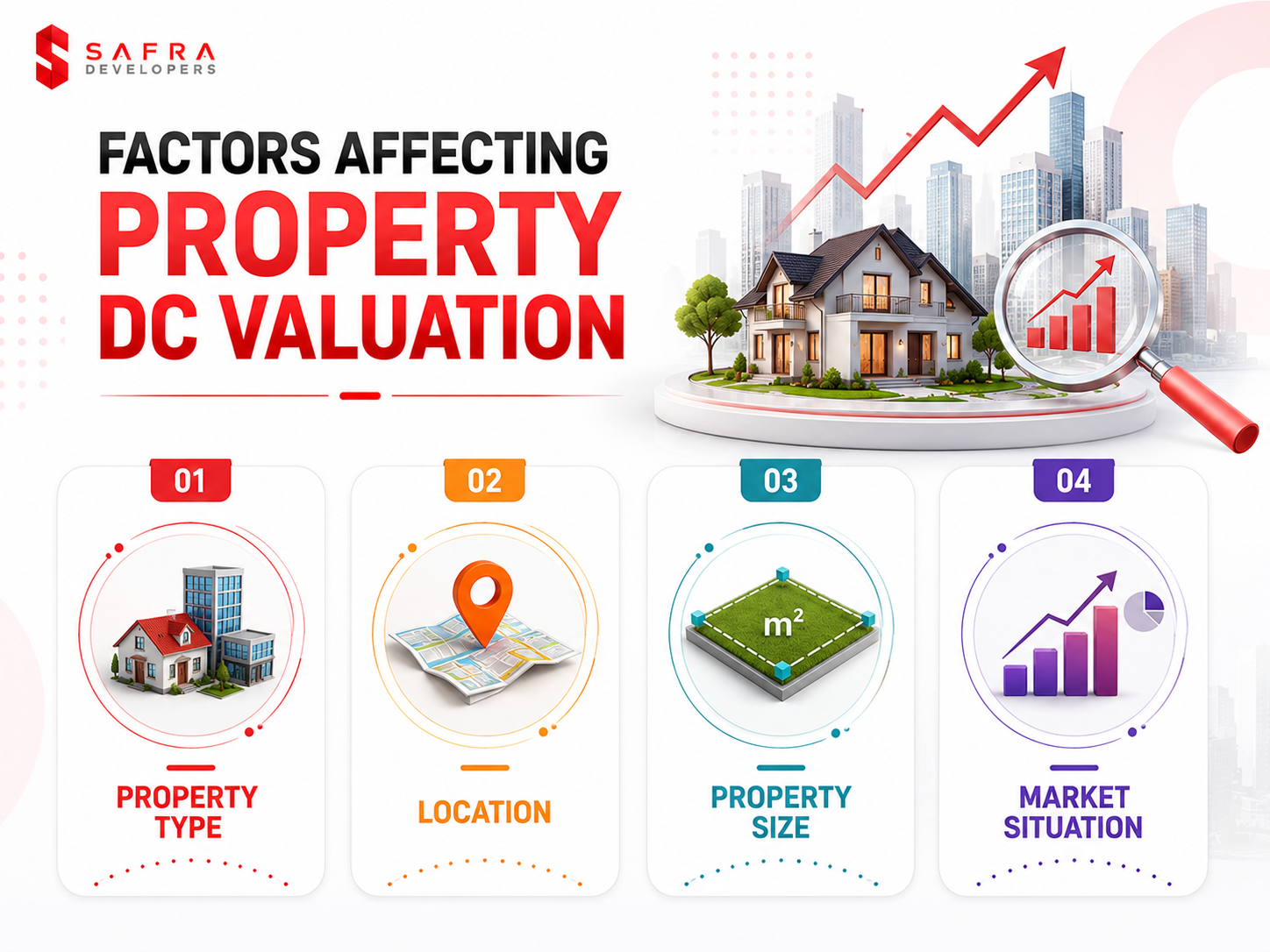
Factors Affecting Property DC Valuation
The DC value of a property is greatly influenced by certain factors, most notable of which are discussed as follows
- Property Type: Different property types such as residential, commercial and agricultural have different DC values. Commercial and agricultural properties that can generate appreciable revenue are rated higher than residential properties.
- Location: The location in terms of urbanization affects the DC values of a property. Rural properties have lower DC value in comparison to urban properties. Even within cities, properties closer to urban centers are valued more than sub-urban areas.
- Property size: DC values are assigned on bases of area so large-sized properties have higher DC rates than small-sized properties.
- Market situations: The DC values are revised in response to market turbulence where an overall market appreciation results in an increase in DC rates.
Taxes Determined Through Property DC Values
Taxation is mainly determined by property DC values by the government. Some main taxes which are determined through DC rates include:
- Withholding Tax
- Stamp duty
- Property registration charges
- Capital Value Tax
E-Stamps in Property DC Valuation
DC valuation of properties require proper documentations which can sometimes be a hectic and arduous task. Currently, Punjab and Sindh have introduced e-stamps in DC valuation which increases process authenticity and convenience. E-stamped DC values can also be verified through online portals of Punjab and Sindh.
How to Determine DC Value of Your Property
The DC office usually sets a fixed amount for an area of land which can be in squarefoot or marla. Therefore, DC value can be determined by multiplying the DC rate of a unit of area with total area of property. However, this requires an accurate measure of the current DC rate of the piece of land in a specific area.
Buyers and owners can determine this through:
Online: For Punjab and Sindh, online portals have been developed from where DC rates can be determined.
Physical visits: Inquirers can visit the district offices of their areas and can look for official rate lists.
Expert Guidance: To avoid confusion, real estate agencies or property lawyers can be consulted for guidance in the matter. Safra Developers is a trusted property expert in the market which can provide professional guidance. Safra Developers can be contacted through website or office visit.
Difference between market values and DC values and FBR values
DC value is different from market value as market value is the result of interaction of different factors such as customer demand, invested capital, available features etc. Market value undergoes frequent fluctuations due to change in any involved factor. Whereas, DC value is a fixed value assigned by DC of the area which acts as the standard or minimum possible rate of the property. Therefore it cannot be changed through market dynamics. This means market values are often higher than the DC values.
While DC values mainly aim to set a standard for efficient local tax collection, FBR sets its values with the regulatory aims to avoid people from declaring their property to be under value. The main goal here is to deal with tax frauds. Due to this reason, FBR values are much closer to market rates unlike DC rates which are minimal rates determined for taxations.
| Aspect | DC Value (Deputy Commissioner Rate) | Market Value | FBR Value (Federal Board of Revenue Rate) |
|---|---|---|---|
| Definition | Government-set minimum property value by district administration | Actual price agreed between buyer and seller | Property value set by the Federal Board of Revenue |
| Authority | Deputy Commissioner (District Government) | Buyers & Sellers (Market forces) | Federal Board of Revenue (FBR) |
| Purpose | To calculate provincial taxes and duties | To determine real transaction price | To calculate federal taxes |
| Basis of Calculation | Fixed rate per unit area (marla, sq. ft., etc.) | Demand, supply, location, development | Predefined valuation tables for cities |
| Relation to Market | Usually much lower than market value | Reflects real-time market conditions | Closer to market value than DC rates |
| Flexibility | Fixed and less frequently updated | Highly flexible and changes frequently | Periodically updated |
| Variation Across Areas | Varies by locality and district | Varies widely based on demand | Standardized for major cities |
| Role in Property Transfer | Mandatory for registration process | Represents actual deal value | Used for tax documentation |
| Update Frequency | Occasional | Continuous (daily market changes) | Periodic (announced by FBR) |
DC valuation for property therefore is an effective managerial strategy developed by the deputy commissioner office to provide a standardized value to each property on the basis of which taxes can then be collected. This allows accurate tax collection, market regulation and providing investment insights. The value varies with location, size and characteristics of properties and is maintained in land record systems.